

Jacob Jan Founder, Scalable
Writes about commerce AI and creative operations.
Tool comparison
Scalable vs Higgsfield for Amazon A+ content: pretty isn't the same as converting
A general AI image studio and a purpose-built e-commerce platform are not the same tool for the same job. Here is how to tell them apart before your next A+ page goes live.
TLDR
- You can spend days making a detail page that looks stunning and still watch it sell exactly like the old one did.
- The problem usually isn't how pretty the images are. It's whether they say the right things, in the right order, to close the sale.
- Looking good and converting are two different jobs, and most AI tools are built for the first one.
- Here's how to tell which kind of tool you're actually buying, so your next page earns its place instead of just decorating it.
You finally rebuilt the detail page. The images are crisp, the lighting is expensive, the whole thing looks like a brand 3 sizes bigger than yours. Then the conversion rate does not move, and you are left staring at a beautiful page that sells like the last one.
That is the trap with using a general AI generator for Amazon A+ content. Beautiful is the easy part now, whether you reach for ChatGPT, Midjourney, or Higgsfield. The hard part, the part that pays, is building modules that convince a shopper to buy. This is where the choice between a broad creative tool and a purpose-built platform like Scalable stops being about who draws nicer pixels.
Can you use a general AI image generator like Higgsfield for Amazon A+ content?
Quick answer
You can generate good-looking images with a general tool, but Higgsfield has no Amazon or A+ features: no review or competitor data, no A+ module formats, no listing strategy, and no Amazon-ready export. It is a general video and image studio. Scalable is built for the job: it turns your real reviews and competitor data into A+ modules designed to convert, in minutes, with no prompting.
Both tools can hand you an attractive image. Only one of them is built to make that image sell on an Amazon detail page. The rest of this piece is about why that gap matters more than it looks, and how to decide which tool fits your work.
What Amazon A+ content is actually for
A+ content, once called enhanced brand content, is not decoration. Amazon describes it as the tool that lets you showcase your products and tell your brand story on the detail page with enhanced images, text placements, and comparison charts [1]. Its job is conversion.
And the payoff is real. By Amazon's own numbers, Basic A+ Content can increase sales by up to 8%, and well-implemented Premium A+ Content by up to 20% [1]. Read that phrase again: well-implemented. The lift is not a reward for pretty pictures. It rewards modules that answer the right questions in the right order.
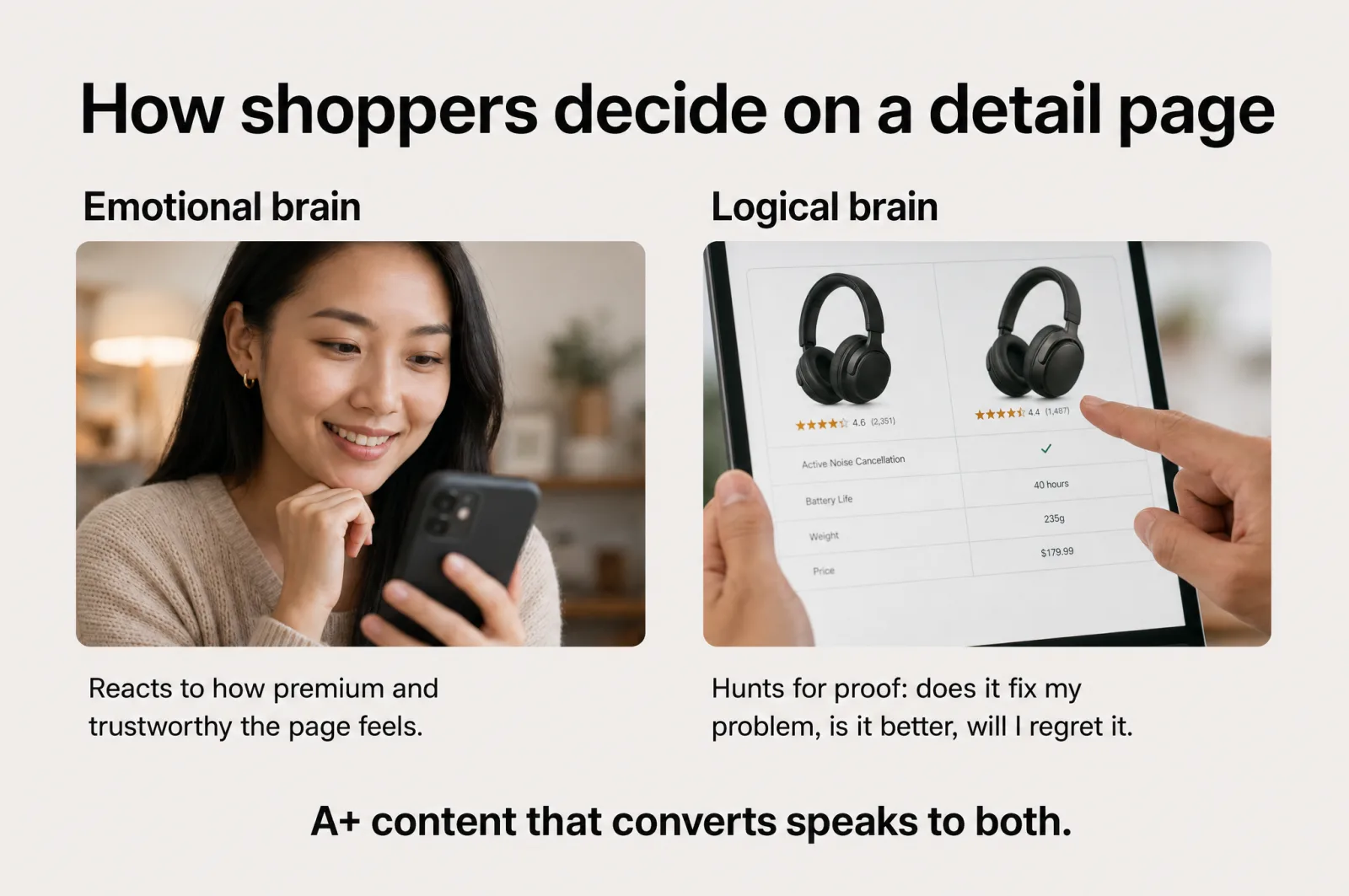
Shoppers decide with two brains at once. The emotional brain reacts to how premium and trustworthy the page feels. The logical brain hunts for the specific proof it needs before spending money: does this fix my problem, is it better than the 3 tabs I have open, will I regret it. A+ content that converts speaks to both. It looks the part, and it argues the case.
A general image generator can nail the first half of that. It has no way to know the second, because it never saw your reviews, your competitors, or the objections your buyers raise. That gap is the whole story of this comparison.
Scalable and Higgsfield, side by side
Both are strong tools aimed at different work, so let's be fair to each.
Higgsfield is a generative AI video and image platform [2]. It bundles many top models into one workspace and is best known for cinematic video with real camera-motion control. It even has a Marketing Studio that turns a product into a social-style video ad in UGC, TikTok, and commercial formats [3]. Its Soul model produces high-aesthetic, photoreal imagery from a large library of style presets [4]. Pricing for individuals starts around $19/mo on a credit system [5]. Everything runs on prompts and creative direction: you describe what you want, pick presets, and steer the result.
Scalable is a purpose-built content platform for e-commerce. You add a product by its ASIN, and it reads the listing plus up to 500 real reviews and the competition, then turns that into a conversion strategy and launch-ready assets: main image, gallery, A+ content, and ads. On brand, in minutes, with no prompting. It is not trying to be a cinematic video studio. It is trying to make your Amazon page sell.
One is a broad creative studio. The other is a specialist. For A+ content, specialist is not a nice-to-have, and here is why.
What A+ content actually needs to convert
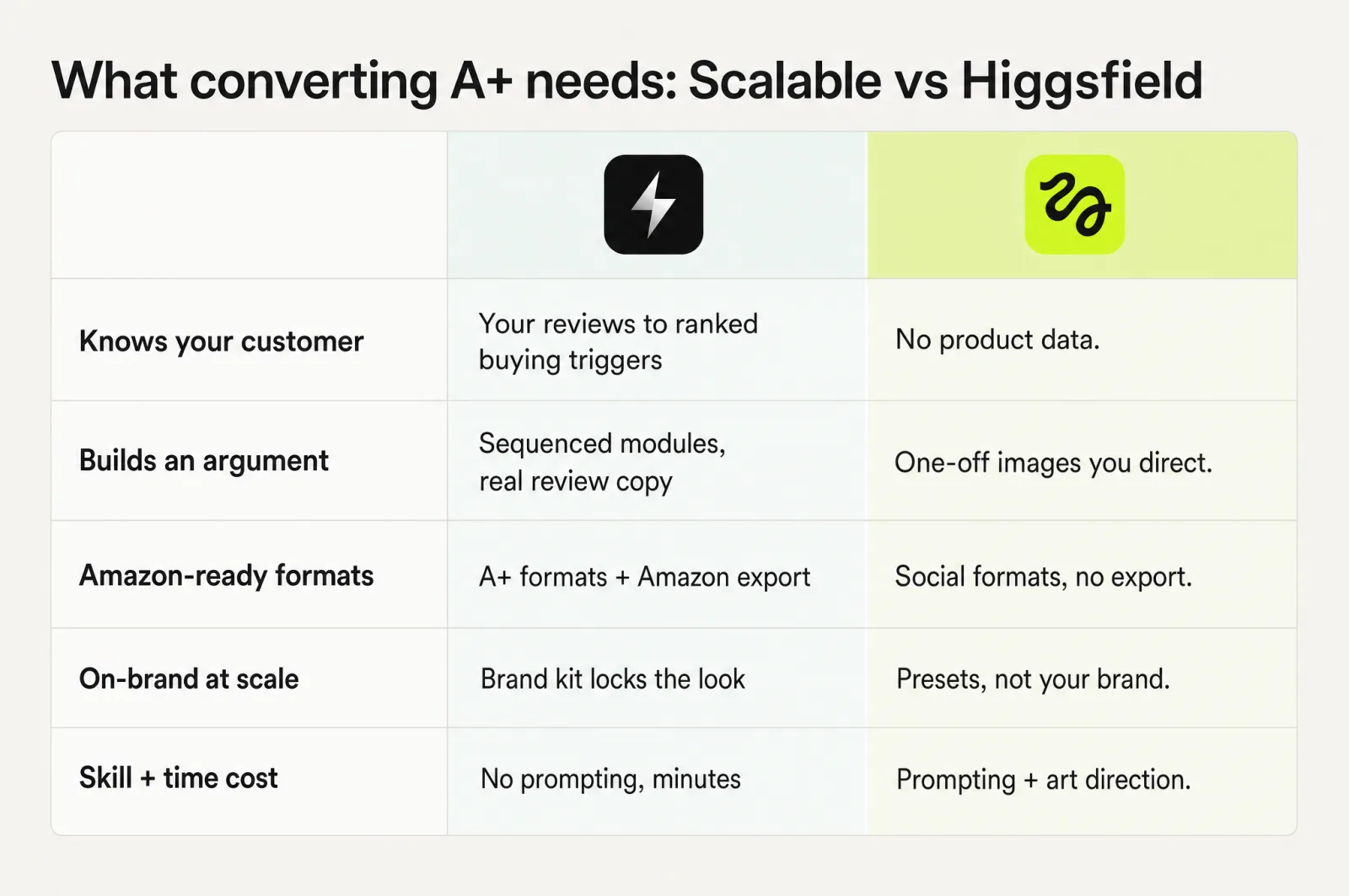
Forget feature lists for a second. A converting A+ page needs 5 things. Here is how each tool holds up against them.
| What converting A+ needs | Scalable | Higgsfield |
|---|---|---|
| Knows your customer (data) | Reads your reviews + competitors into ranked buying triggers and gaps | No product or review data; you supply the idea |
| Builds an argument, not one image | Sequenced modules with on-image copy from real review language | One-off renders you art-direct yourself |
| Amazon-ready formats + export | A+ module formats and Amazon-ready export built in | Social and general formats; no Amazon export |
| Stays on-brand across the page | Brand kit locks color, type, and vibe across every module and product | Prompt-to-prompt; presets are styles, not your brand |
| Skill and time cost | No prompting; a full stack in minutes | Prompt engineering and creative direction |
Does it know your customer?
This one decides everything downstream. A shopper does not buy because your image is sharp. They buy because it answers the exact worry that was stopping them.
Scalable finds those worries for you. It reads your reviews and your competitors' listings and ranks the real conversion drivers and the communication gaps: the things buyers care about that your page never addresses. Say a run of reviews complains the clasp feels flimsy. That objection becomes an A+ module that shows the reinforced clasp in close-up, before it ever costs you a sale. Every module gets briefed the same way, from evidence.
Higgsfield starts from a blank prompt box. It is powerful, but it does not know that your buyers keep asking whether the strap fits a wrist under 6 inches, or that your top competitor loses on battery life. You might, if you have read every review yourself. The tool cannot, so the strategy stays on you.
Does it build an argument, or just an image?
A+ content is not one hero shot. It is a sequence: confirm the promise, show the differentiator, handle the objection, close. Scalable lays the page out as a data-backed argument, module by module, with on-image copy pulled from the words your customers use.
A general generator gives you images one at a time. Beautiful ones. But stitching 8 of them into a page that builds toward a sale, in the right order, with the right copy, is on you. That is what separates a gallery from a conversion engine, and it is where most A+ content examples quietly fall short.
Is it Amazon-ready?
Amazon A+ has its own module formats, its own comparison charts, its own spec for what goes where. Scalable produces A+ as a channel with the right formats, and it can recompose a finished gallery image into an A+ module without a reshoot. The output is built for the destination, not bent to fit it after the fact.
Higgsfield's closest product, Marketing Studio, is built for social and UGC video ads, not Amazon detail pages [3]. Those are great for Meta and TikTok. They are the wrong shape and the wrong intent for an A+ module, and you will be reformatting by hand.
Does it stay on-brand across the page?
A page whose modules each look slightly different reads as amateur, no matter how nice any single frame is. Scalable's brand kit locks your color, type, and vibe once, and every generation inherits it, so the page looks like one brand. That consistency then holds across your next product and the one after, which is the part that matters when you are scaling a catalog rather than polishing one listing.
With a prompt-driven tool, consistency is something you fight for on every image. Style presets give you a look, but not your look, held steady across a full page and a growing range of SKUs.
What does it cost you in skill and time?
Higgsfield rewards people who can prompt and art-direct. That is a real skill, and if you have it, the ceiling is high. If you do not, the output is only as good as your direction, and good Amazon A+ content design is a lot to ask of a text box.
Scalable is built so that no prompting is required. You add a product and the strategy and copy are already there. Onboarding gets most sellers to a polished result in under 5 min, and a full A+ stack lands in about 12 min. The skill it asks of you is knowing your product, which you already have.
Where Higgsfield genuinely wins
None of this makes Higgsfield a weak tool. It makes it a different one.
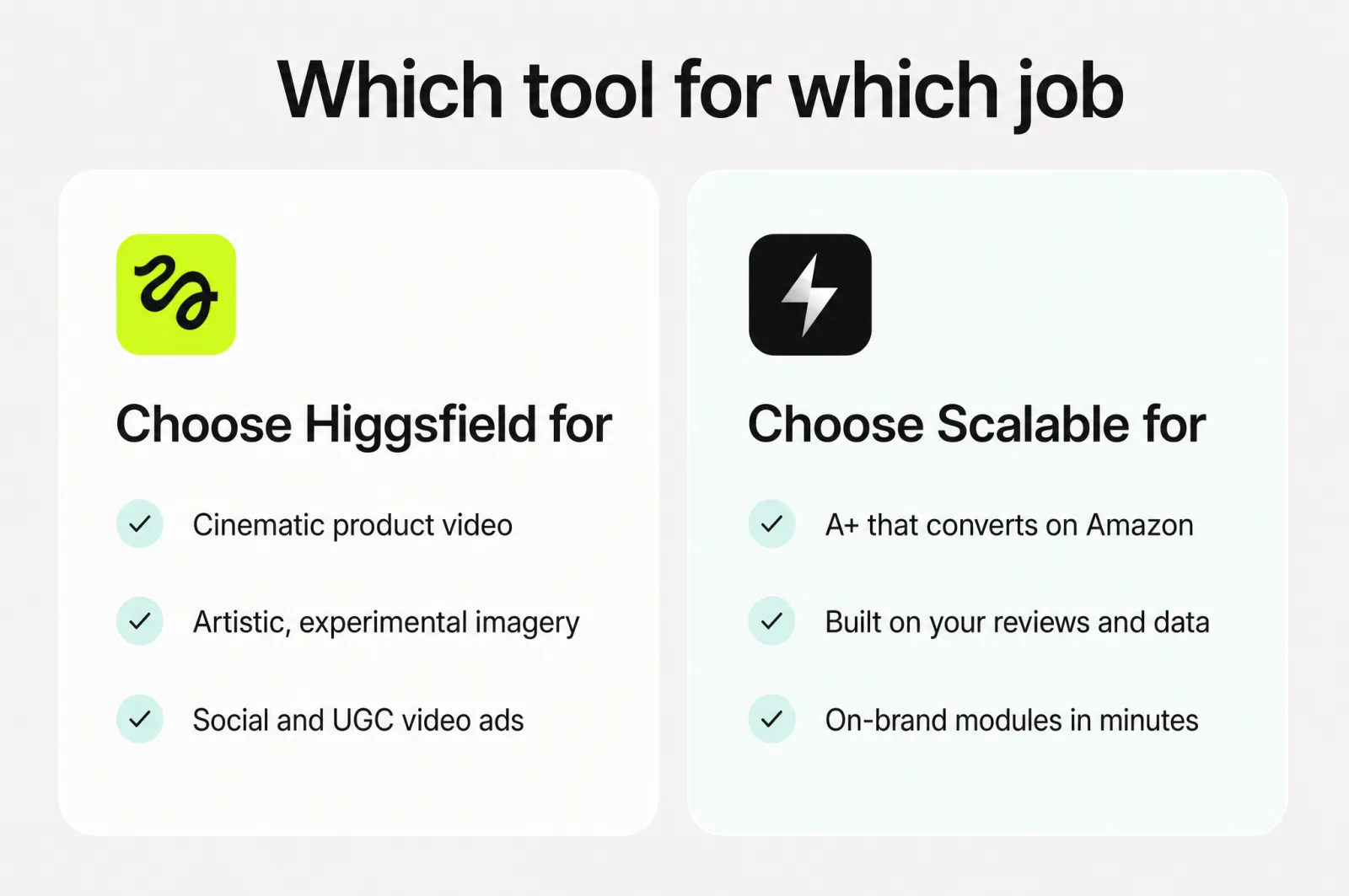
If you want cinematic product video with dramatic camera moves, Higgsfield is excellent and Scalable is not the tool [2]. For artistic, experimental, scroll-stopping imagery with a huge range of aesthetic styles, Soul is a joy to play with [4]. And when your next campaign is a UGC or TikTok-style video ad, Marketing Studio is built for exactly that [3].
Those are real creative jobs, and a specialist Amazon tool will not do them. Reach for Higgsfield when the work is broad creative production and video. The mistake is only in expecting a general studio to double as your Amazon conversion engine.
So which should you use for Amazon A+ content?
Start from the outcome you want, not the tool.
If you want A+ content that converts on Amazon, and you would rather not moonlight as a prompt engineer, a purpose-built platform wins. Scalable knows your customer from your own reviews, builds the page as an argument, keeps it on brand across the catalog, and hands you Amazon-ready modules in minutes. For a solo seller that means agency-grade output without the agency. For a growing brand it means scaling A+ across SKUs on-brand, without hiring a creative team or waiting weeks on one. That is the whole gap between a page that looks expensive and a page that sells.
If your priority is cinematic video, artistic range, or social ad content, Higgsfield is the better studio, and worth the prompting it asks for.
The same logic holds for any general AI tool you might reach for. We ran the same head-to-head with ChatGPT's image model, and the gap was identical: the model can draw, but it cannot build the listing. It is the difference between AI product photography that looks good and a listing built to convert.
Most sellers reading this are trying to make an Amazon page pay. For that, a tool built for it is the safer bet.
See it on your own product
The fastest way to feel the difference is to stop weighing tools in the abstract and watch one work on your real listing.
Add your product to Scalable and it reads your reviews and turns them into an A+ module built to convert, before you spend a cent. The free start includes your first product and your first brand kit, so you can judge the result on the listing you already know. No prompting, no design skills, no gamble on whether the pretty version will sell.
Try it on the page you were about to rebuild, and let the data show you what it has been missing.
Frequently asked questions
- Can Higgsfield make Amazon A+ content?
Higgsfield can generate images and video you could try to place in an A+ page, but it has no Amazon A+ features: no review or competitor data, no A+ module formats, no listing strategy, and no Amazon-ready export. Its product-ad tool makes social and UGC-style video ads, a different format than Amazon detail-page A+ modules.
- Does Amazon A+ content actually increase sales?
Yes. By Amazon's own figures, Basic A+ Content can increase sales by up to 8%, and well-implemented Premium A+ Content by up to 20%. The lift comes from A+ modules that answer real buyer questions and objections on the detail page, not from images that only look good.
- What makes A+ content convert instead of just looking good?
Converting A+ is built on evidence and sequenced as an argument. It leads with the buying triggers from your real reviews, answers the objections shoppers actually raise, stays on-brand across every module, and fits Amazon's formats. Visual polish is the baseline; the job is communicating the right things in the right order.
- Is Scalable or Higgsfield better for Amazon sellers?
For Amazon A+ content specifically, Scalable is purpose-built: it turns your reviews and competitor data into module-formatted A+ designed to convert, in minutes, with no prompting. Higgsfield is the stronger pick for cinematic video, artistic imagery, and social or UGC video ads, which is a different creative job.
Sources
- 1.Amazon: A+ Content
- 2.Higgsfield: AI video and image platform
- 3.Higgsfield: Marketing Studio
- 4.Higgsfield: Soul image model
- 5.Higgsfield: Pricing
- 6.Get a full Amazon A+ content stack in minutes, on-brand, in-house
- 7.AI product photography for Amazon: ChatGPT vs Scalable
- 8.Scalable vs Google Nano Banana Pro: which AI product image generator builds a listing that sells?
- 9.Your listing image looks the part. But does it make its case?
Built by someone who’s lived it.
I’ve been in e-commerce since 2018. I built and exited my own brand, then spent 5+ years running a creative agency for product companies, shipping the listings, ads, and content that move real sales.
Filed under
Launch your full Amazon listing in minutes, in-house and on-brand
Main image, gallery, A+, ads, translations and variations. Built on your reviews, optimized for conversion.
Next recommended read
Get a full Amazon A+ content stack in minutes, on-brand, in-house
Amazon A+ content used to mean an agency and weeks of waiting. Here's how to produce a full, on-brand A+ stack in-house, in minutes.
6 min read
More on this topic — playbooks and product deep-dives.

AI product photography for Amazon: ChatGPT vs Scalable
AI product photography for Amazon, head to head: where ChatGPT's image model stops and what building a listing that converts takes.

How to make an Amazon main image that wins the click
Your Amazon main image decides the click. Learn what moves CTR, what the rules allow, and how to test a portfolio of proven strategies fast.

Scalable vs Google Nano Banana Pro: which AI product image generator builds a listing that sells?
Scalable vs Google Nano Banana Pro: can a raw AI product image generator build an Amazon listing that converts? An honest, feature-by-feature comparison.