

Jacob Jan Founder, Scalable
Writes about commerce AI and creative operations.
Marketplace expansion
Amazon listing translation isn't enough: how to localize a listing that sells abroad
Word-for-word translation ships a listing that reads foreign and sells like it. Localization is the difference, and it's not the project it used to be.
TLDR
- You spent real time and money getting your listing right at home. Drop it into a new country with a word-for-word translation and it quietly reads foreign, and shoppers there scroll past.
- Selling in a new market is a localization job, not a translation job. The words on your images, the claims that land, even the search terms all change by country.
- You can get this right yourself, without hiring a translator and a designer for every marketplace you enter.
- Here's the localization checklist for a listing that sells abroad, and the fastest way to roll it out across every market.
Translation vs localization: what's the difference on Amazon?
Quick answer
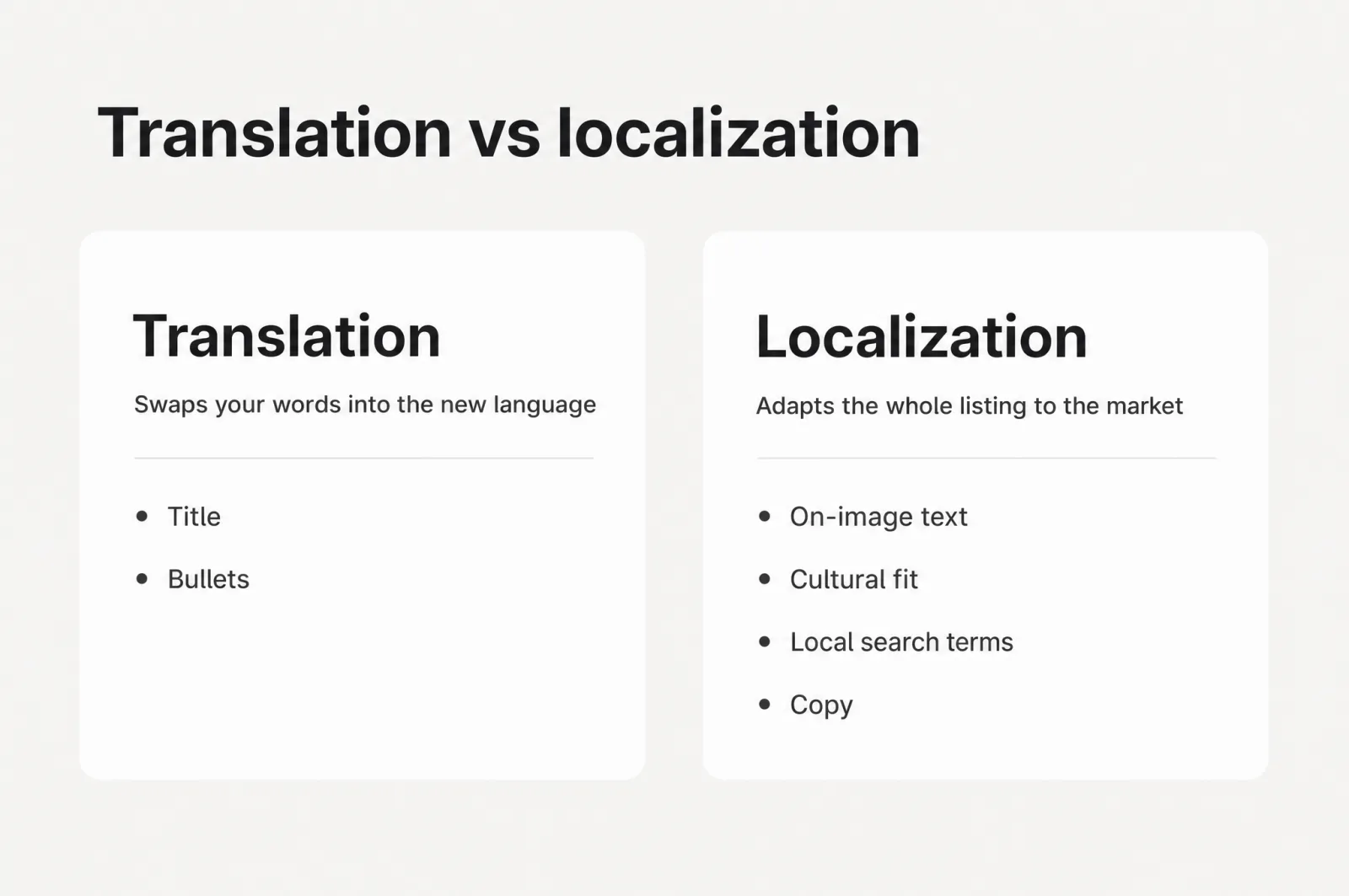
Translation converts your words to a new language. Localization adapts the entire listing to the new market: the claims that persuade, the search terms shoppers type, cultural conventions, and the text rendered inside your main image and gallery. A translated listing is understood. A localized listing is bought. On Amazon, where the images carry your sales pitch, that gap decides whether expansion pays off.
The trap: you're about to "just translate" your listing
You built a listing that works. The main image earns the click, the gallery answers the objections, the copy is tuned to your reviews. Now you're opening Germany, France, or Japan, and Amazon listing translation looks like the last box to check: run the text through a translator and go live.
That plan ships a listing that reads foreign. Shoppers punish it quietly, before they judge the product.
The data is blunt. Across 29 countries, 76% of shoppers prefer to buy products with information in their own language, and 40% will not buy from listings in another language at all [1]. In Germany, 57% buy only at local-language sites [1]. A stiff, machine-translated listing does not read as neutral. It reads as "not for me," and the shopper scrolls on.
So the real risk of a fast translation is not a wrong word here and there. It is a listing that technically works and underperforms in a market you paid to enter. You find out months later, in the sales numbers, when the fix is expensive.
Why translation isn't localization on Amazon
Word-for-word translation misses 3 things that decide whether a listing sells abroad. On Amazon, all 3 hit hard.
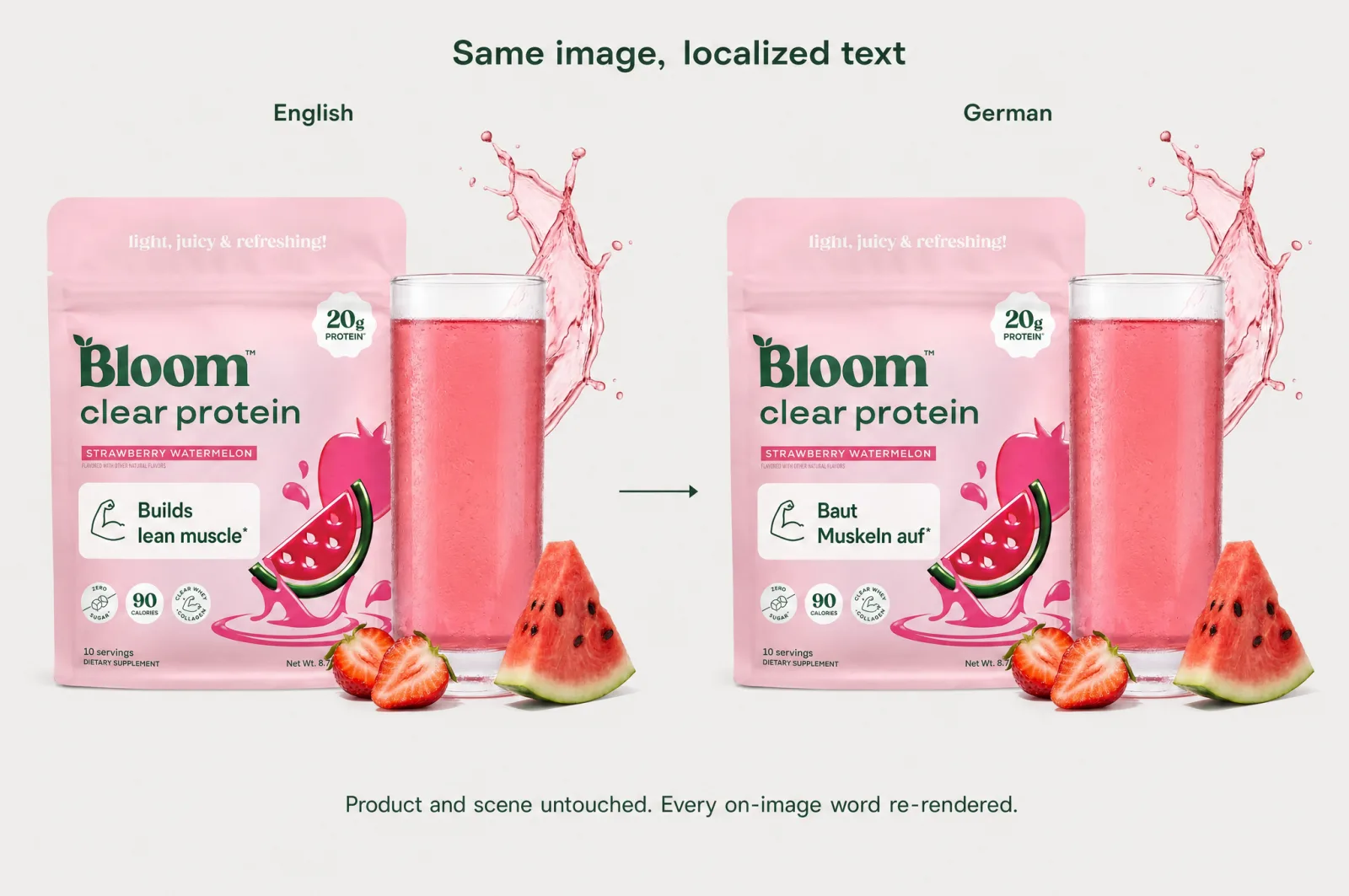
Your image text is pixels, not copy fields. The headlines, callouts, and badges baked into your main image and gallery are artwork, not editable text. A tool that swaps your title and bullet points leaves every word on those graphics in the original language. Since visuals carry most of the persuasion on a mobile listing, a "translated" product page often still sells in English through its pictures. That is the single most common miss, and the hardest to fix by hand.
Search terms are different in every language. Shoppers in each market type different words for the same product, so good localization builds a separate keyword list per marketplace instead of translating your English terms [2]. Translate "clear protein powder" literally into German and you can miss the phrase local shoppers actually search. The listing is correct and invisible at the same time.
Claims and conventions are cultural. What reassures a US buyer can fall flat, or read as pushy, elsewhere. Units, formats, humor, and the order you make your case all shift by market. Localization adapts the message; translation just carries the words across.
There's a fourth surprise: Amazon will not do this for you. On its own seller blog, Amazon says it provides no translator and points sellers to hire one through its Service Provider Network [3]. Whatever you upload is what shoppers see, so the quality bar is entirely yours.
The localization checklist: what "done right" requires
Here's what a listing that converts in a new marketplace needs. Treat it as listing optimization for that market, not a translation task, and use it whether you work by hand or with a tool.
- Re-render the on-image text, slot by slot. Every headline, callout, and badge on the main image and each gallery frame gets rewritten in the target language, with the product and layout untouched. This is the step generic translation skips.
- Adapt culturally, not literally. Rework claims, examples, and formatting for how that market reads and buys. Aim for a native shopper thinking "this was made for me," not "this was translated for me."
- Localize the keywords, not just the copy. Build the search terms from how shoppers in that country actually search, so the listing ranks as well as it reads [2].
- Keep terminology consistent across all 8 slots. Pick one word for each feature and use it everywhere. A listing that names the same benefit 3 different ways across its images looks careless and erodes trust.
- Export in Amazon's format. Each image has to land in the right slot, correctly named and sized, per marketplace. Multiply that by several languages and the file management alone becomes a project.
Miss any one of these and the listing reads translated. Hit all 5 and it reads local. The problem was never that this is impossible. It's that doing it by hand is slow and costly.
The old way is why expansion stalls
Run that checklist by hand and the cost is obvious. You need a translator who understands selling, not just the language. You need a designer to rebuild every image in every language. A freelance pair can run into the hundreds of dollars per listing and take days; an agency runs past a thousand and takes weeks. You pay that per market, before you know the market is worth it.
So most sellers never start. Only about 25% of Amazon sellers operate in more than one country [4], which leaves most catalogs at home while the demand sits abroad. Amazon reports over 11,000 US-based independent sellers grew their sales more than 10X through cross-border selling in 2025 [5]. The room to grow with Amazon international listings is real. The localization tax on the front end is what keeps sellers from reaching it.
That's the real villain here. Not translation quality, but a process that makes you spend the money and the weeks first and learn whether it worked afterward. Selling on Amazon in multiple countries should not be a bet you place blind.
How to localize a full listing in one flow
This is where the work collapses from a per-market project into a single pass. Instead of a translator plus a designer for each country, you localize the finished listing you already have.
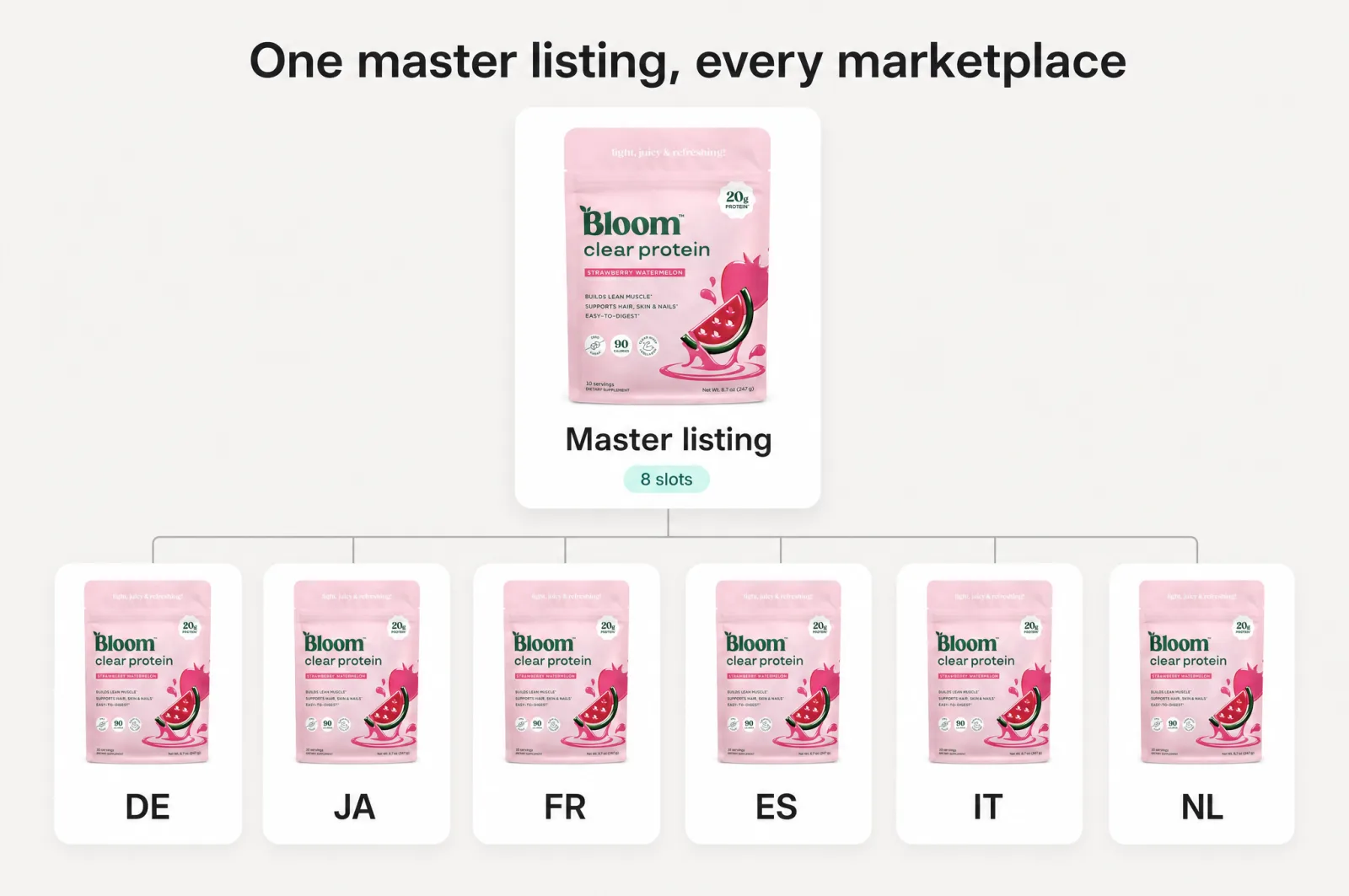
Start from your master listing, all 8 slots. Pick the marketplaces you want, up to 12 languages including German, Japanese, French, Spanish, and more. Every on-image word is re-rendered in the target language while the product and scene stay exactly as they were. The message is adapted to how that market reads, not carried across word for word. Context kept, not just words.
Consistency comes built in. A per-language glossary is created for you, so every one of the 8 image slots names the same feature the same way in that market. No drift, no mixed terminology, no manual proofing across a dozen files.
It holds across a catalog, too. Your brand kit keeps every market on the same colors, type, and look, so a large catalog across a dozen marketplaces still reads as one brand instead of a dozen slightly different ones. What broke consistency in the old model, a different translator and designer per market, is exactly what stays locked here.
Then you generate. Do one language at a time, or batch every market at once. The output arrives as language-coded, Amazon-slot-named ZIPs, ready to upload without renaming a file. Already built product variations? The same flow fans out across them, so every color in every market comes from one project instead of a spreadsheet of tasks.
That is the inversion. The finished listing you're proud of at home becomes a finished listing in every marketplace you sell in, on brand, in minutes, and you own the result. Marketplace expansion stops being a localization project and becomes a step you take the same afternoon you decide to.
Start with one listing and one new market
You don't have to commit the whole catalog to see it work. Pick your best listing and the next market you want to sell in, and localize it end to end: on-image text, cultural adaptation, consistent terminology, and an Amazon-ready export. No design tool, and you don't have to speak the language.
Start free. Your first product and brand kit are on us, so you can run the flow on your own listing before you scale it. You keep your workflow, you own it, and you judge the result before you commit the catalog. See what a listing built for a market, not just translated into it, does to your numbers.
Frequently asked questions
- Does Amazon translate my listing into other languages automatically?
No. Amazon does not localize your content for you. On its own seller blog, Amazon points sellers to hire a translator through its Service Provider Network. The marketplace shows shoppers whatever you upload, so a listing you paste in through machine translation goes live exactly as translated, image text and all.
- What is the difference between translating and localizing an Amazon listing?
Translation swaps words from one language to another. Localization adapts the whole listing to the new market: the claims that land, the search terms shoppers actually type, cultural conventions, and the text baked into your main image and gallery. Translation gets you understood. Localization gets you bought.
- Do I need to localize my listing for every Amazon marketplace?
For any marketplace in a new language, yes. Shoppers strongly prefer buying in their own language, and a listing that reads machine-translated signals low quality before anyone reads a word. Each marketplace also has its own search terms and conventions, so the same product needs its own localized listing per country.
- Does listing translation cover the text on my main image and gallery?
Usually not, and this is the trap. The headlines, callouts, and badges on your images are pixels, not editable copy fields. A text-only translation leaves them in the original language. To localize properly, every on-image word has to be re-rendered in the target language while the product and scene stay untouched.
Sources
- 1.CSA Research: Consumers Prefer Their Own Language (Can't Read, Won't Buy 2020)
- 2.Hooley Brown: 7 tips for translating your Amazon product listings
- 3.Amazon: How to translate product listings for Amazon Global Selling
- 4.Nova Analytics: Amazon Seller Statistics 2026
- 5.Amazon: Expand your business internationally
- 6.Your best Amazon gallery images are hiding in your reviews
- 7.Stop gambling on your Amazon listing
- 8.How to keep a growing catalog on-brand with a brand kit generator
Built by someone who’s lived it.
I’ve been in e-commerce since 2018. I built and exited my own brand, then spent 5+ years running a creative agency for product companies, shipping the listings, ads, and content that move real sales.
Filed under
Launch your full Amazon listing in minutes, in-house and on-brand
Main image, gallery, A+, ads, translations and variations. Built on your reviews, optimized for conversion.
Next recommended read
How to make an Amazon main image that wins the click
Your Amazon main image decides the click. Learn what moves CTR, what the rules allow, and how to test a portfolio of proven strategies fast.
8 min read
More on this topic — playbooks and product deep-dives.

Amazon variations: build a full parent listing in 2 clicks
How to set up Amazon variations (parent-child listings) and get an on-brand image for every color and size, from parent SKU to 2-click generation.

Your best Amazon gallery images are hiding in your reviews
Amazon listing optimization starts in your reviews: a 4-step method to find conversion drivers, close communication gaps, and build gallery images that sell.

Stop gambling on your Amazon listing
Amazon listing optimization is sold as a blind bet: pay, wait weeks, hope it converts. Here is how to own your listing content and see the result first.