

Jacob Jan Founder, Scalable
Writes about commerce AI and creative operations.
Own your content
Stop gambling on your Amazon listing
The old way makes you pay and wait before you can see whether the work converts. You can flip that.
TLDR
- You pick an agency or freelancer on their portfolio, pay upfront, wait weeks, and only learn whether the work converts after the money and time are gone.
- The real problem was never the price. It is that you cannot see the work before you commit to it, so every hire is a bet.
- You do not have to keep betting. You can build your own listing content, on your own brand and data, and see a real result before you spend a cent.
- This is the shift from renting your content to owning it.
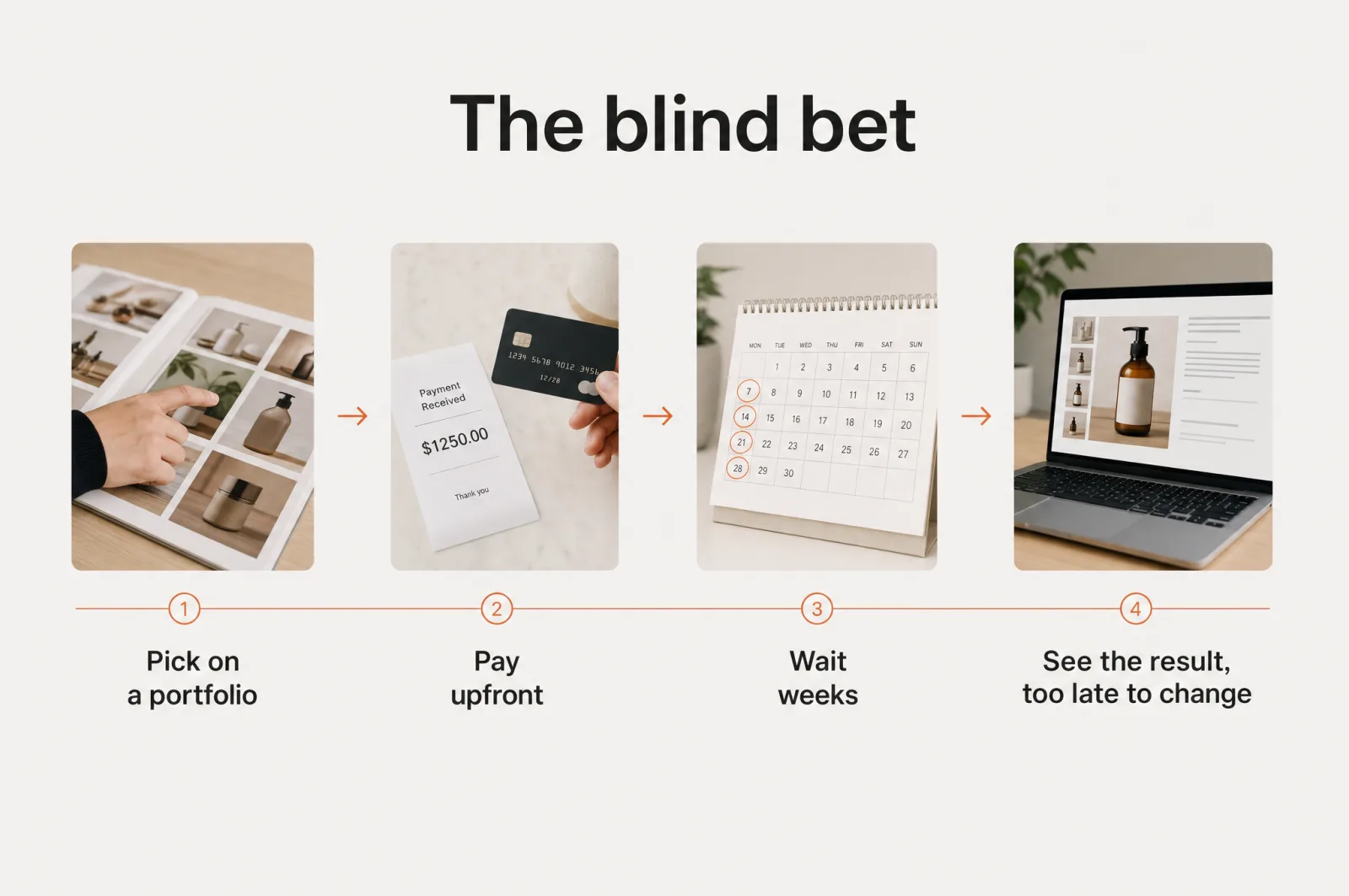
You found the agency. Great portfolio, glowing reviews, a confident quote. You paid, you waited, and weeks later the listing landed. It looked fine. Whether it sells any better is a guess you get to check only after the money is spent.
That is how Amazon listing optimization gets bought today: as a bet. You choose a provider on their past work, commit thousands, and wait to learn whether your own product page will convert. This piece is about why that bet is stacked against you, and how to stop making it.
Why does hiring out your listing feel like a gamble?
Quick answer
Because you commit the money and the weeks before you can see whether the work converts. You pick a provider on a portfolio, approve a quote, and wait. If the result misses, you have already paid for it and lost the launch window. The cost and the wait sting, but the deeper problem is that the outcome stays unverifiable until it is too late to change course.
Think about what you are buying when you hire out a listing. Not images, not copy. You are buying a promise that this shop, on this product, will make something that sells. And you buy that promise blind.
A portfolio shows you their best work for other brands. It cannot tell you how they will handle your reviews, your category, your buyer. So you judge on reputation and a good sales call, sign off, and hand over control. The work comes back long after the decision is locked, and by then your only options are to ship it or start over.
Even the honest, talented shops cannot escape this. The problem is not whether they are good. You had to decide before you could see, and no amount of vetting turns a portfolio into proof about your product.
What Amazon listing optimization costs you
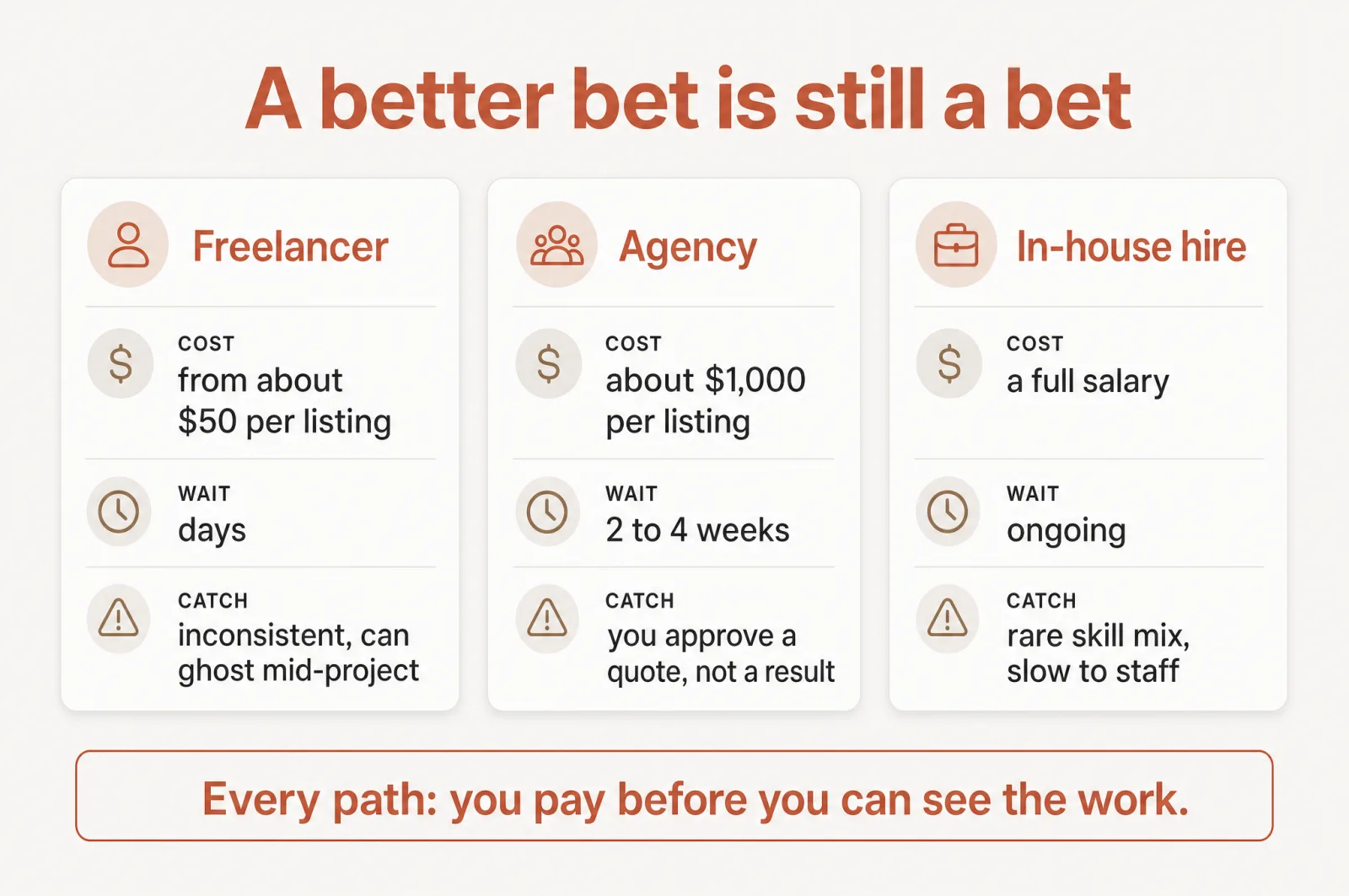
The sticker price is the part everyone argues about, and it is real. Industry guides put this work anywhere from roughly $50 per listing on budget freelance platforms to $5,000+ per month for full-service agency management [1]. Per-listing agency projects commonly land near $1,000, and range from $500 to $3,000+ depending on scope [2]. Bringing the work in-house is its own bill. A capable creative hire costs a full salary, and the rare mix of analytical and creative skill you need is hard to find and harder to keep.
Then there is time. A one-time optimization project typically takes 3 to 14 days, and 2 to 4 weeks once images or A+ content are in scope [1]. Every one of those weeks is a week a new product stays offline, or a weak page keeps underperforming.
| The old way | Cost | Wait | The catch |
|---|---|---|---|
| Freelancer | ~$50 to a few hundred per listing | days | inconsistent, and they can ghost mid-project |
| Agency | ~$1,000 per listing, up to $5,000+/mo | 2 to 4 weeks | you approve a quote, not a result |
| In-house hire | a full salary | ongoing | rare skill mix, slow to staff and lead |
The invoice is only the visible cost. Weak creative quietly caps click-through and conversion on every SKU, month after month, and you rarely trace a flat sales line back to a mediocre main image. The upside is just as hidden until you claim it. One analysis found that products with professional-quality photos convert about 33% higher than low-quality ones [3]. That gap runs against you the whole time you wait.
Now multiply it by a catalog. The bet is not a one-time decision. It repeats on every new SKU, every seasonal refresh, every variant, so a 100-product catalog is 100 quotes, 100 waits, and 100 chances the work misses. For a solo owner that is the fear of looking amateurish next to bigger brands. For a growing brand it is content becoming the bottleneck on every launch. Same bet, bigger stakes.
Why hiring a better service won't fix it
The natural response to a bad experience is to bet smarter next time. A pricier agency. A freelancer with more reviews. A referral from someone you trust. Reasonable moves, and none of them change the shape of the deal.
You still choose on a portfolio, and you still pay before you can see the work on your product. A better Amazon listing optimization service raises your floor, maybe. It does not make the outcome visible any sooner. Well-regarded shops deliver misses too, because the one thing you needed to verify, whether this converts for you, was never something a sales call could show.
Here is the lens worth keeping, whatever you decide: if you cannot see the result before you commit, you are gambling, however good the house. That holds for an agency, a freelancer, a new hire, or a generic AI tool. The problem was never that you kept picking the wrong people. You made rational choices with the only information you had, a portfolio and a promise. The process itself is the flaw.
So the fix is not a better bet. It is a different game, one where you see the work before you pay for it.
The fix isn't a better bet. It's owning it.
Owning your content flips the sequence that makes the old way a gamble. Instead of commit, wait, and hope, you produce a real result first and decide with it in front of you.
That is only fair if it does not demand the skills you were paying to avoid, and it does not. There is no prompting, no design work, and no product photography to commission. An Amazon listing optimization tool built on your own reviews, competitors, and audience does the thinking, so the content answers what your shoppers care about instead of a stranger's guess about your category.
The de-risk is the whole point. A free tier lets you add your first product and see the output before you pay anything. You keep your workflow instead of adopting someone else's. Your first full stack of listing images arrives in about 12 min, after under 5 min of setup. A brand kit locks your color, type, and style in about 6 min, so the result looks like your brand, not like generic AI product photography.
It all runs inside Amazon's rules by default, which lowers the risk of a suppressed listing while you move fast.
None of that asks you to trust a black box. You look at the real output, on your real product, before a cent leaves your account. It is your product, your data, and your listing, not a sample built on someone else's. Seeing beats believing, which is exactly what a burned buyer needs and exactly what a portfolio can never offer.
The shift underneath is an identity one. You stop being the person who briefs vendors and waits, and become the person who owns a predictable content system. It is not about doing more work. It is about holding the wheel, so the quality of your listings stops depending on someone you cannot see and starts depending on a system you control. Outsourcer to owner.
Own your Amazon listing content in one flow
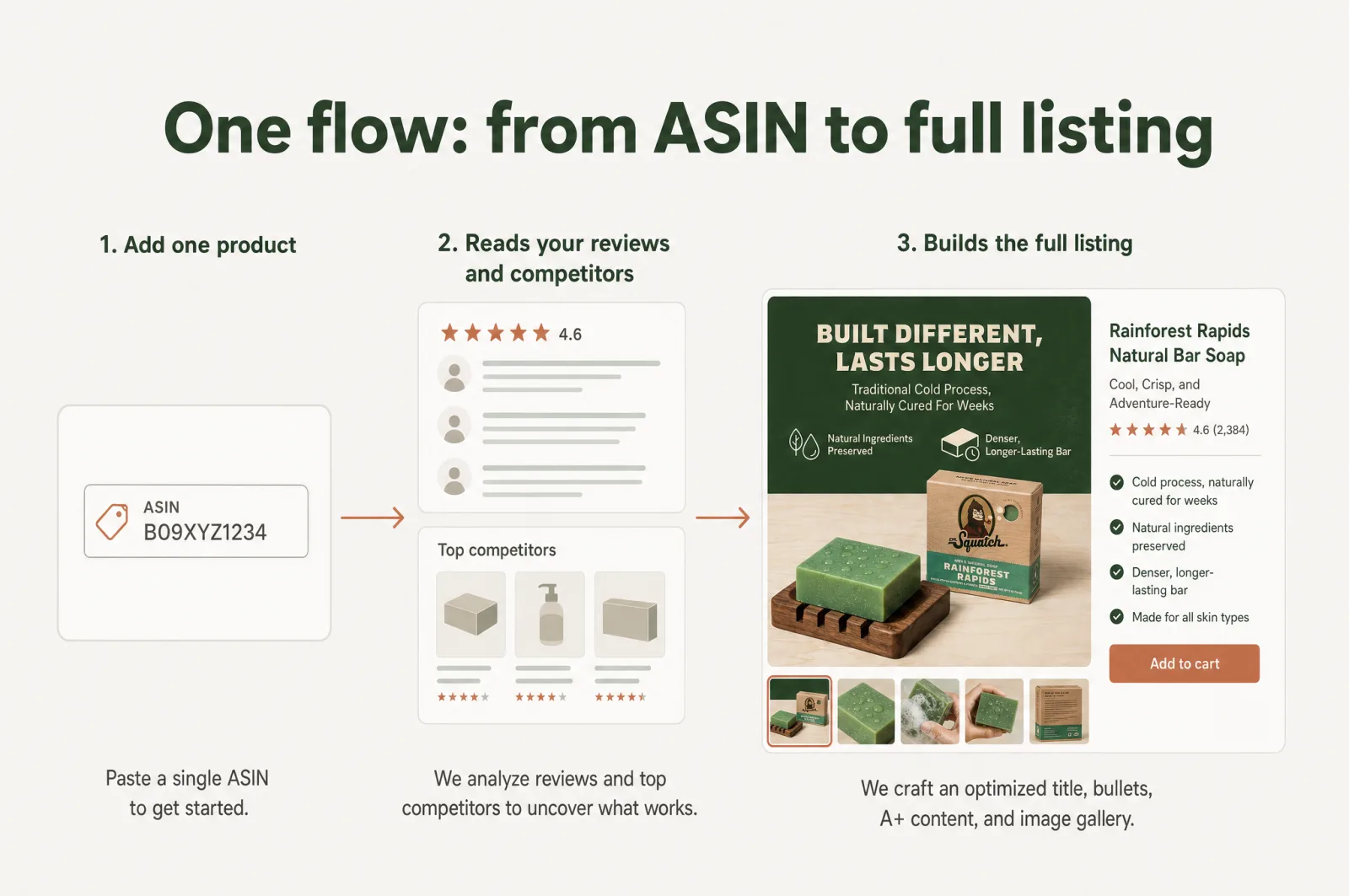
Owning it does not mean stitching together five tools and doing an agency's job yourself. It means one flow, start to finish.
You add a product with a single ASIN. The tool reads up to 500 of its reviews and its competitors. It turns them into a conversion strategy: what each image should say, and in what order, to move a shopper from click to purchase. From there you build the whole listing, not one image. You get a main image tuned for click-through, 7 gallery images that carry the sales argument, A+ content, and ads, all on brand because your brand kit steers every one of them.
You are not just looking at images either. Each slot shows the reasoning behind it and the exact review and competitor signals it answers, so you can see why a line earns its place on the page. That is the real shift: you stop approving a vendor's taste and start verifying your own strategy.
When the stack is done, you adapt it instead of redoing it. Variations produce the image set for every color and material in a parent listing. Translations re-render the listing into up to 12 Amazon marketplace languages, the meaning kept, not just the words. Anything you want to refine, you edit in place: erase a prop, fix a caption, change a format. No Photoshop, no re-brief. When it is ready, you export the set as Amazon-ready files and upload on your own schedule.
On-brand at volume is the part a growing catalog cares about most, and it holds by design. One brand kit governs every image, every variant, and every marketplace, so 100 SKUs still look like one brand rather than five vendors.
This is not a promise you take on faith. Brands and agencies run about 12,000 products and generate more than 127,000 assets through this flow every month, and more than 7,500 of them now run their content in-house without a creative team. The proof is the output you can see for yourself, on your own product, today.
See your first listing before you commit
You have paid for the blind bet before. You know how it ends: an invoice, a wait, and a result you did not get to see coming.
Run it the other way now. Add one product, watch a real listing get built on your own data, and judge it with your own eyes before you spend anything. Keep it if it earns its place, on one SKU or across the whole catalog. That is what owning your content means, and it is the last time a great listing has to feel like a gamble.
Start free, and see the result first.
Frequently asked questions
- How much does Amazon listing optimization cost?
Agencies and freelancers price it across a wide band. Industry guides put it anywhere from about $50 per listing on budget freelance platforms to $5,000+ per month for full-service agency management, with per-listing agency work often landing near $1,000 and ranging from $500 to $3,000+. The spread depends on scope, catalog size, and whether images and A+ content are included.
- Can I optimize my Amazon listing myself without a designer?
Yes. You no longer need design, photography, or prompting skills to produce launch-ready listing content. A tool built on your own reviews and competitor data can turn one product into a full listing, on brand, so you approve the result instead of briefing a stranger and hoping. Owning it in-house is now realistic for a solo seller, not just a team with a creative bench.
- Will AI-generated listing content convert?
It depends entirely on what the content is built on. Generic AI images look polished and say nothing. Content built on your product's real reviews, competitors, and ranked conversion drivers is designed around what makes shoppers buy, not around aesthetics. The point of owning it is that you can see the result and test it before you commit, so conversion is something you verify rather than hope for.
- How long does listing optimization take?
Hiring it out, a one-time project usually runs 3 to 14 days, and 2 to 4 weeks once images or A+ content are involved. Doing it yourself with the right tool collapses that: the effort to add a product and pick a brand direction takes under 5 min, and a full first stack of listing images arrives in about 12 min.
Sources
- 1.Eva.guru: Best Amazon Listing Optimization Services (2026 Guide)
- 2.SalesDuo: Best Amazon Listing Optimization Agencies for Sellers
- 3.Blendnow: Do Better Product Photos Really Increase Sales?
- 4.How to make an Amazon main image that wins the click
- 5.Get a full Amazon A+ content stack in minutes, on-brand, in-house
- 6.AI product photography for Amazon: ChatGPT vs Scalable
- 7.Amazon listing optimization: turn 8 images into an ordered sales pitch
- 8.The Q4 catalog refresh: Amazon listing optimization for peak season without a photoshoot
Built by someone who’s lived it.
I’ve been in e-commerce since 2018. I built and exited my own brand, then spent 5+ years running a creative agency for product companies, shipping the listings, ads, and content that move real sales.
Filed under
Launch your full Amazon listing in minutes, in-house and on-brand
Main image, gallery, A+, ads, translations and variations. Built on your reviews, optimized for conversion.
Next recommended read
How to make an Amazon main image that wins the click
Your Amazon main image decides the click. Learn what moves CTR, what the rules allow, and how to test a portfolio of proven strategies fast.
8 min read
More on this topic — playbooks and product deep-dives.

Get a full Amazon A+ content stack in minutes, on-brand, in-house
Amazon A+ content used to mean an agency and weeks of waiting. Here's how to produce a full, on-brand A+ stack in-house, in minutes.

AI product photography for Amazon: ChatGPT vs Scalable
AI product photography for Amazon, head to head: where ChatGPT's image model stops and what building a listing that converts takes.

Amazon listing optimization: turn 8 images into an ordered sales pitch
Amazon listing optimization is sequencing, not a photo shoot. Design 8 listing images as an ordered sales pitch and run it across your catalog.