

Jacob Jan Founder, Scalable
Writes about commerce AI and creative operations.
Listing optimization
Get a full Amazon A+ content stack in minutes, on-brand, in-house
The agency-and-designer model for A+ content is over. You can own the whole stack yourself.
TLDR
- You know the drill: an invoice, a few weeks of waiting, and A+ content that still comes back a little off-brand.
- The bottleneck was never you. It was a production process built on other people's calendars.
- You can build the whole thing yourself, on-brand, without a designer and without becoming one.
- Here's what "in minutes, on-brand, in-house" takes, and why it beats the old way.
Get a full Amazon A+ content stack in minutes, on-brand, in-house
If you have ever paid to get Amazon A+ content made, you know the shape of it. You brief an agency or a freelancer. You wait. You get modules back that are close, but the color is slightly off and the copy misses the point your reviews keep making.
You send notes. You wait again. Weeks later it goes live, and you have spent more than you wanted on something you could almost have made yourself. That model is ending. Not because A+ content matters less, but because the expertise you used to outsource now lives inside the tool. This is the case for bringing it in-house, and what it takes to do it well.
What is Amazon A+ content, and why does it move the needle?
Quick answer
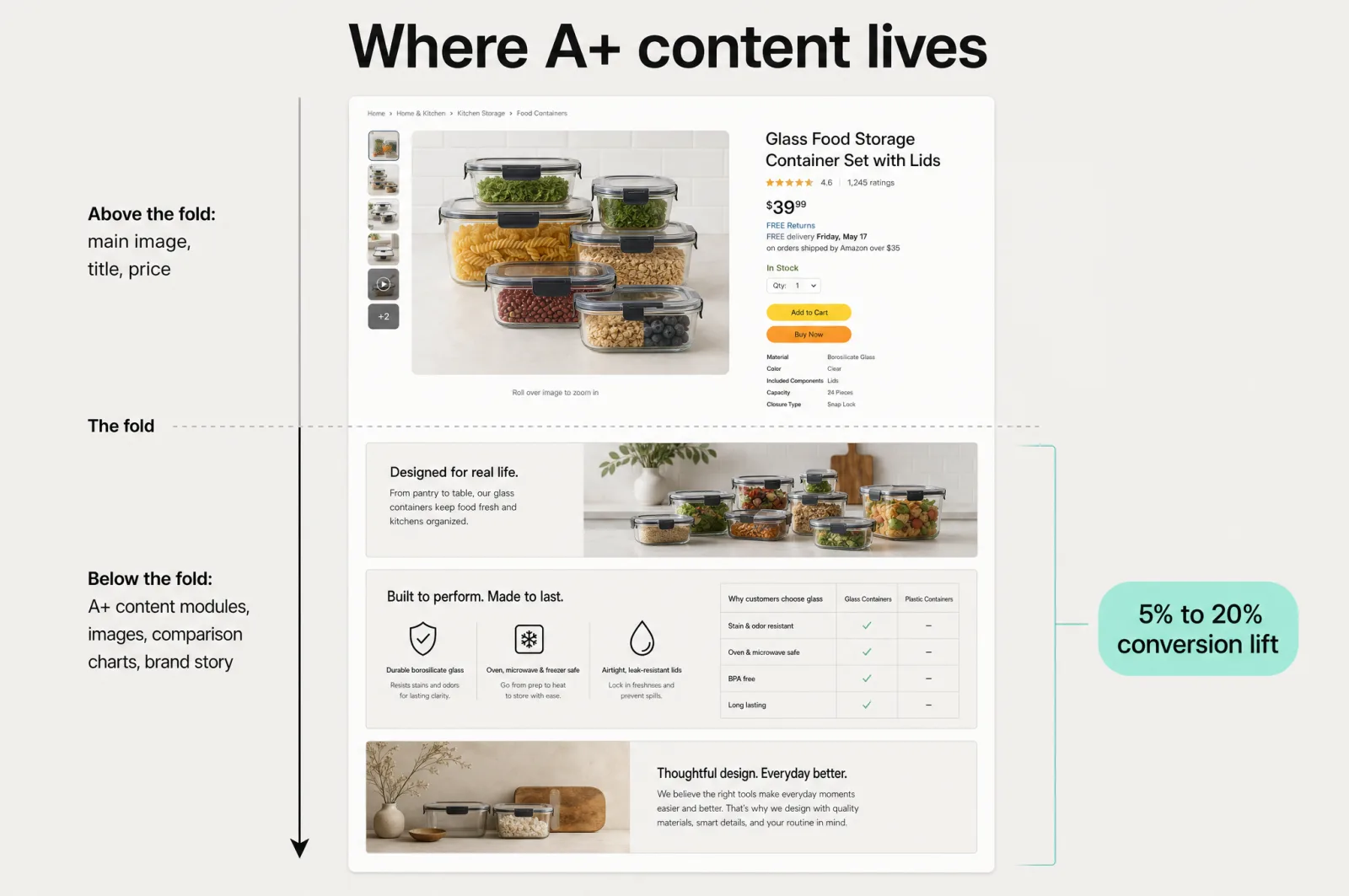
Amazon A+ content is the rich module area below the fold on a product detail page, where brand-registered sellers replace the plain text description with images, comparison charts, and brand storytelling. Formerly called Enhanced Brand Content, it is where a shopper decides whether to trust you. Amazon reports it can lift conversion by roughly 5% to 20%.
A+ content, formerly known as Enhanced Brand Content [1], is prime conversion real estate. It sits where a shopper goes when they are still deciding: past the price, past the main image, into the part of the page that answers "is this for me?"
Done right, it is not decoration. It is the modules that handle objections, show the product in context, and make the premium price feel obvious. Amazon reports A+ content can lift conversion by 5% to 20% [2]. Across a catalog, strong A+ content becomes one of the highest-leverage moves in Amazon listing optimization.
The old way is broken
Here is the part nobody says out loud: Amazon does not charge you to publish A+ content. Basic A+ is free for brand-registered sellers [3]. The canvas costs nothing. Everything you have paid for is production: the design, the copy, and the imagery.
And production has been expensive. A freelancer runs $300 to $725, an agency $700 to $3,000 [4]. Multiply that across a catalog and a single refresh turns into a five-figure line item. Then Amazon still takes about 8 business days to review and publish each submission [3], on top of the days or weeks production took.
The ways out were never great:
| Path | What it costs you |
|---|---|
| Agency | The most money and the least control. Weeks per round, and you still QA every module. |
| Freelancer | Cheaper, but slow to brief, easy to lose, and rarely on-brand across a catalog. |
| Hire in-house | A salaried designer gets you the fastest turnaround and the biggest fixed cost, hard to find and harder to keep. |
| Do it yourself | Free in cash, brutal in time and skill. The fallback most of us reach for when money is tight, and the worst use of your hours. |
None of these failed because of you. They failed because the model wedges a slow, manual production step between you and a page you already understand.
What changed: in-house is finally the smart move
For years, outsourcing made sense for one reason. The work needed three rare skills: conversion strategy, design, and copy. Most owners have one, maybe two. So you rented the rest.
AI moved those skills into the software. The strategy comes from your own reviews and competitors. The design comes from models trained on launch-ready imagery. The copy comes from what your buyers say.
Bringing A+ in-house is no longer the scrappy, lower-quality option. Now it is faster and better, because the tool carries the expertise you used to rent. Pro-level A+ content no longer needs a pro budget. It needs the right tool and your product knowledge, which you already have.
What "in minutes, on-brand, in-house" takes
The phrase only means something if the flow holds up. Here it is, start to finish.
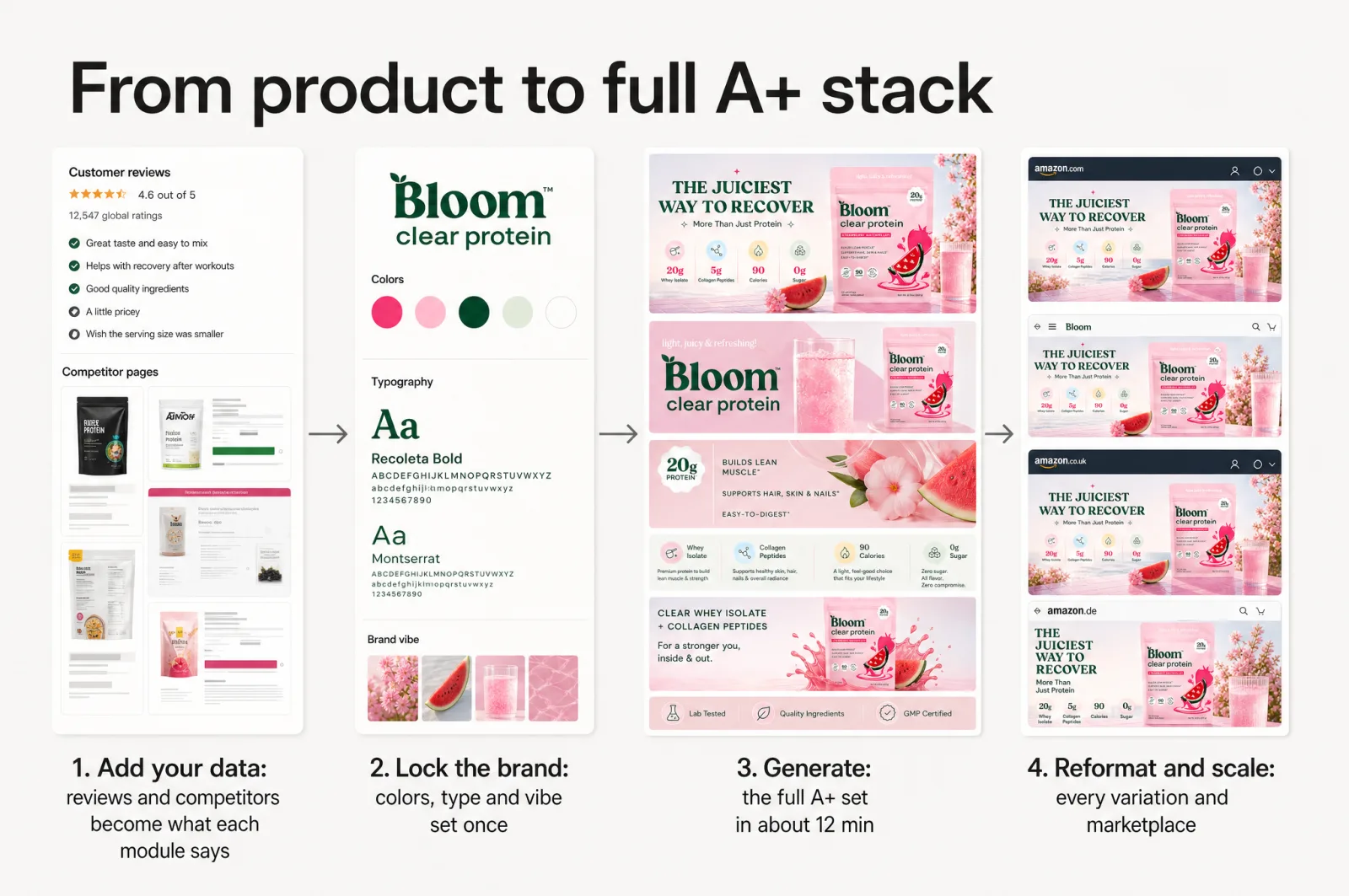
Start with your data, not a blank canvas. Add a product and Scalable reads up to 500 of your reviews and competitors, then turns them into what each module should say. You are not staring at an empty page wondering how to fill six modules. The plan arrives first, built on evidence.
Lock the brand once. A brand kit fixes your colors, type, vibe, and even your models, so every module comes out looking designed instead of "close," without you touching Photoshop or knowing a single hex code. Set it once and it holds across every SKU, so a growing catalog stays on-brand instead of drifting from one listing to the next.
Generate the full stack. With the plan and brand locked, you generate the complete A+ set, no prompting and no design skills required. The tool handles the Amazon A+ content design end to end: colors, type, and layout. We measured it: a full A+ stack in about 12 min. Not one module. The whole page.
Refine, reformat, and scale. Swap an element, fix text, or recompose a module into another aspect ratio without a separate design tool. The same locked plan and brand regenerate across every variation and marketplace, so a 40-SKU catalog can ship as fast as a single listing.
That is the difference between owning A+ content and renting it. The expensive, slow steps, the strategy, the design, the revisions, collapse into one flow you run.
But will it convert, and not look like slop?
Two fair questions, because most AI output earns the doubt.
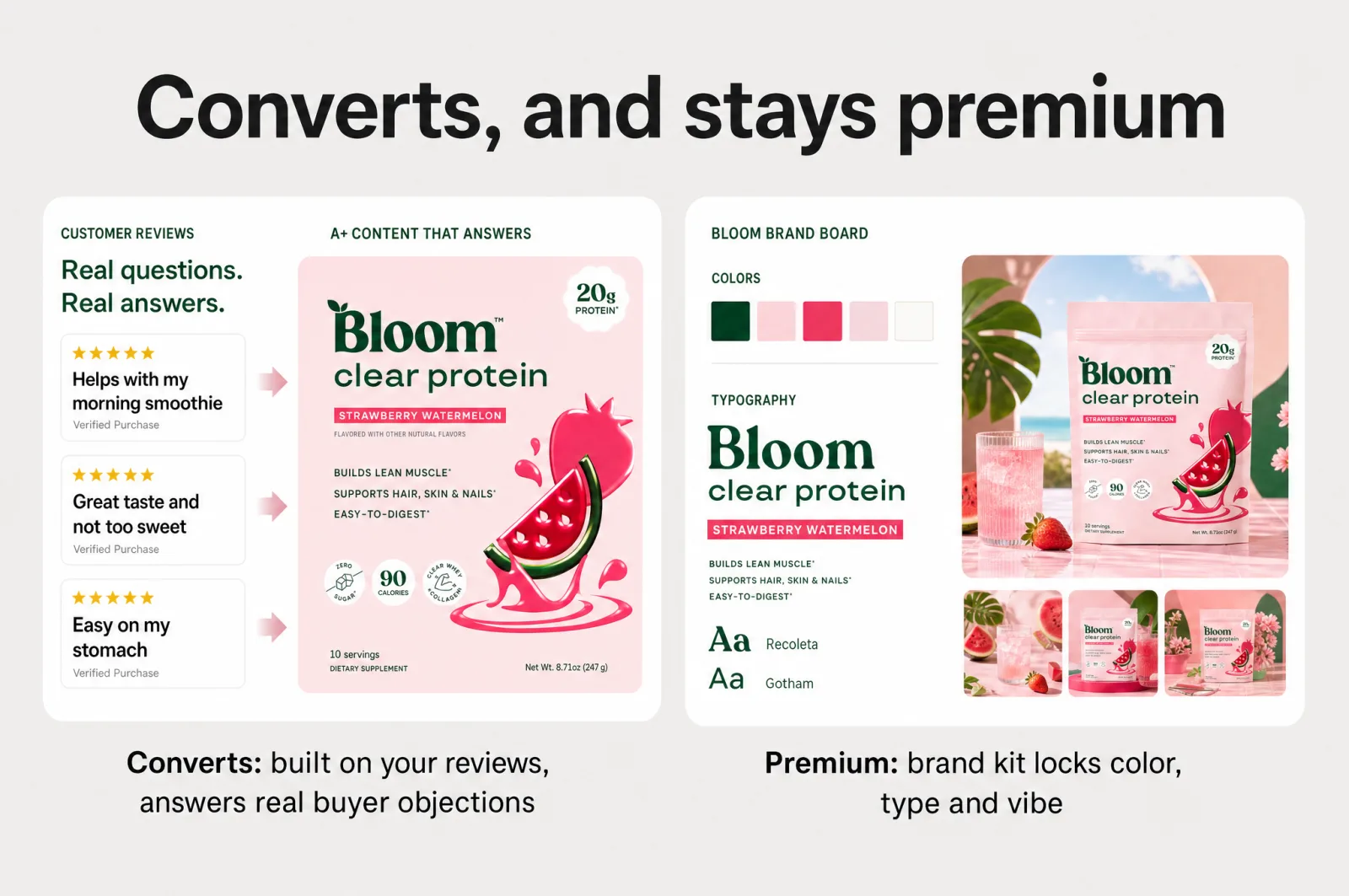
It converts because it is specific, not stock. The modules are built on your reviews, so they answer the objections buyers keep raising instead of guessing at what might sell. That is the point of A+ content, done from evidence rather than assumption.
The output stays premium because the brand kit holds the line. Locked color, type, and vibe separate on-brand work from the AI slop everyone is right to fear. You can see A+ content examples on the detail pages of brands like OxiClean, Garden of Life, and Beurer, who run this same flow across their catalogs and ship more than 127k assets a month. The one-person workflow a solo seller runs is the same one these teams run at scale.
Own it
You do not need a budget, a designer, or a spare 3 weeks to publish A+ content you are proud of. You need your product and an afternoon, and honestly less than that.
Start on the free plan, add one product, and generate your first A+ stack from your own reviews. Then roll the same locked brand across the rest of your catalog. You will know inside the first stack whether this replaces the invoice you have been dreading.
Frequently asked questions
- How much does Amazon A+ content cost?
Publishing Basic A+ content on Amazon is free for brand-registered sellers. The real cost is producing the modules. A freelancer typically charges $300 to $725 per listing and an agency $700 to $3,000, plus days or weeks of back-and-forth. Producing the same stack in-house with an AI tool drops that to minutes and a fraction of the cost.
- Is Amazon A+ content worth it?
Yes for most brand-registered sellers. Amazon reports A+ content can lift conversion by roughly 5% to 20%, because the modules answer buyer questions and justify the price right where the decision happens. The gain compounds across a catalog, so the real question is not whether to use A+ but how cheaply and consistently you can produce it.
- What is enhanced brand content?
Enhanced Brand Content (EBC) is the old name for what Amazon now calls A+ content. It is the same feature: the rich module area below the fold on a product page, where brand-registered sellers replace the plain text description with images, comparison charts, and brand storytelling. If a guide says EBC, read it as A+ content.
Sources
- 1.Salsify: Amazon A+ Content 101
- 2.Amazon: A+ Content (Sell on Amazon)
- 3.Amazon Seller Central: A+ Content guide
- 4.Marissa Puttagio: Amazon graphic design pricing
- 5.How to make an Amazon main image that wins the click
- 6.Amazon variations: build a full parent listing in 2 clicks
- 7.Stop gambling on your Amazon listing
- 8.How to keep a growing catalog on-brand with a brand kit generator
Built by someone who’s lived it.
I’ve been in e-commerce since 2018. I built and exited my own brand, then spent 5+ years running a creative agency for product companies, shipping the listings, ads, and content that move real sales.
Filed under
Launch your full Amazon listing in minutes, in-house and on-brand
Main image, gallery, A+, ads, translations and variations. Built on your reviews, optimized for conversion.
Next recommended read
How to make an Amazon main image that wins the click
Your Amazon main image decides the click. Learn what moves CTR, what the rules allow, and how to test a portfolio of proven strategies fast.
8 min read
More on this topic — playbooks and product deep-dives.

Amazon variations: build a full parent listing in 2 clicks
How to set up Amazon variations (parent-child listings) and get an on-brand image for every color and size, from parent SKU to 2-click generation.

Stop gambling on your Amazon listing
Amazon listing optimization is sold as a blind bet: pay, wait weeks, hope it converts. Here is how to own your listing content and see the result first.

How to keep a growing catalog on-brand with a brand kit generator
An inconsistent catalog leaks trust and sales. See how a brand kit generator locks your brand once so every listing stays on-brand as you scale.