

Jacob Jan Founder, Scalable
Writes about commerce AI and creative operations.
Comparison
Scalable vs Google Nano Banana Pro: which AI product image generator builds a listing that sells?
Google's Nano Banana Pro is a stunning image engine. Here is why an engine still is not a listing, and what that means for your catalog.
TLDR
- You have watched the demos, and yes, the images are stunning. The quiet worry is whether all that beauty will sell your product.
- Making a pretty picture and building a page that converts are two different jobs. One takes a prompt. The other takes knowing what your buyers care about.
- A raw image model hands you a file and leaves the strategy, the art direction, and the guesswork to you.
- Here is an honest look at where each tool wins, so you can pick the one that fits the outcome you need.
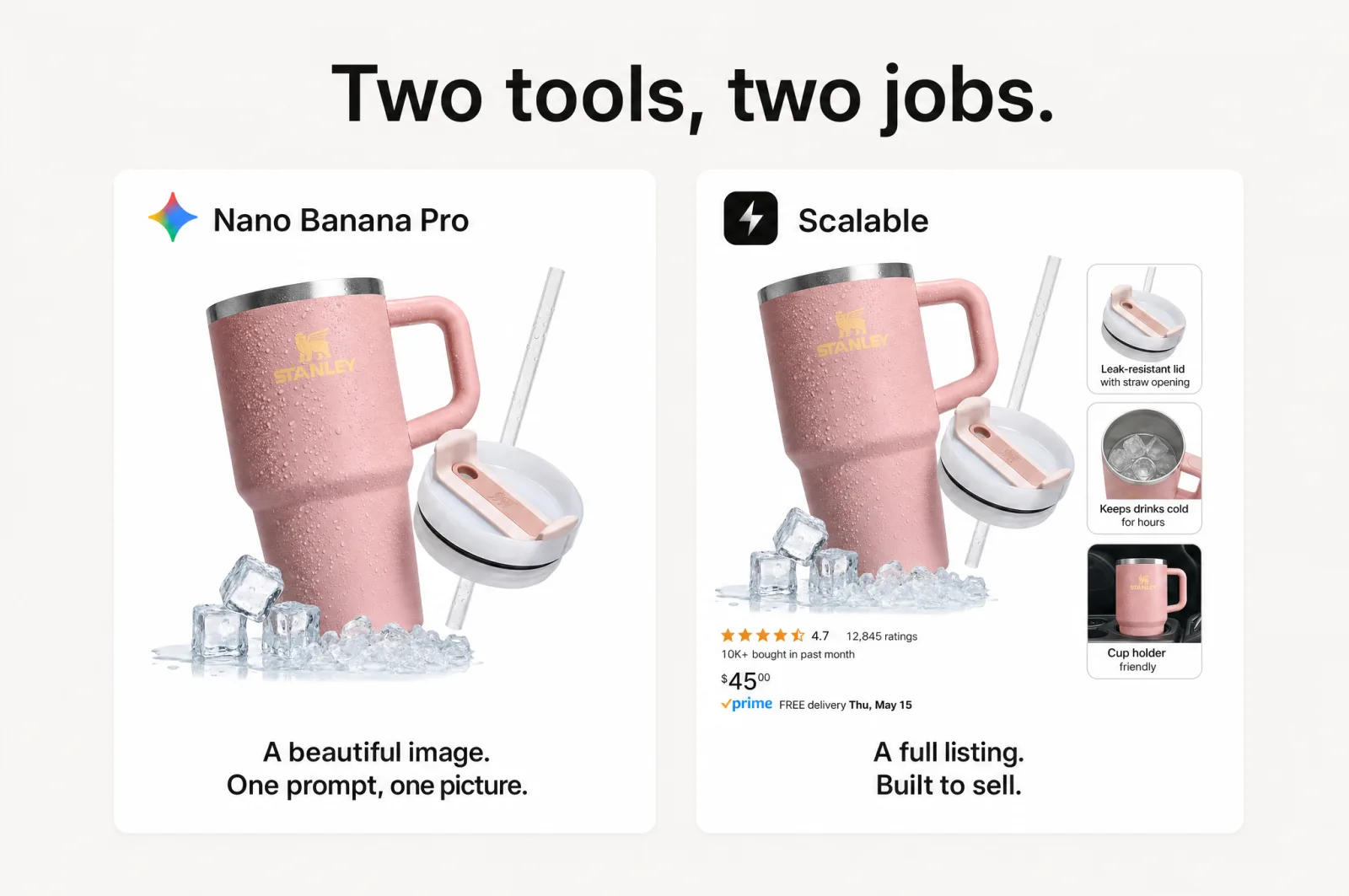
Is Nano Banana Pro good for building product listings?
Quick answer
Nano Banana Pro is one of the best AI product image generators available, with 4K output and near-perfect in-image text. For a product listing, though, the image is only half the job. It has no knowledge of your reviews, your competitors, or what makes shoppers click and buy, so you provide all of that yourself. A listing that converts needs strategy built on data, not just a beautiful render, and that is a different tool for a different job.
Let us start by being fair, because most comparison posts are not.
Google's Nano Banana Pro is excellent. If you have played with it and felt a small thrill at the output, that reaction is correct. So this is not a piece about why one AI product image generator is secretly bad and another is secretly good. It is about a quieter question that matters far more for your catalog: does a beautiful image sell your product, or does something else?
The honest answer reframes the whole comparison. The model was never the hard part. Knowing what to make, and why, is.
What Nano Banana Pro is, and where it shines
Nano Banana Pro is Google DeepMind's name for Gemini 3 Pro Image, released in November 2025 and built on the Gemini 3 Pro reasoning model [1]. It is the grown-up successor to the viral Nano Banana editing model, and it is a serious piece of technology.
Here is what it does well, credited plainly:
- Text that finally works. For years the giveaway of an AI image was garbled text. Nano Banana Pro renders legible, accurate text directly in the image, across long paragraphs and multiple languages [1]. This alone solves a problem that used to send people back to Photoshop.
- Real reasoning and world knowledge. Because it is built on Gemini 3 Pro, it can reason about a scene and even pull live information through Google Search to build accurate infographics and diagrams [1].
- High resolution. It generates at 1K, 2K, and up to 4K, ready for print and premium placements [2].
- Everywhere you already are. You can reach it in the Gemini app, Google AI Studio, the API, Vertex AI, and even Google Ads [1].
- Cheap per image. Priced by usage, it runs up to roughly $0.24 per image at 4K, and less at lower resolutions [3].
If your job is to make a striking one-off visual, a mockup, a poster, or an infographic, this is one of the best tools on the planet. Full stop.
So where is the catch? There is not one, exactly. There is just a gap between what a model does and what a listing needs.
What a listing needs that a model cannot give you
Point a raw image model at your product and you become three people at once: the strategist, the art director, and the prompt engineer. The model renders your prompt beautifully. Whether the prompt was right is your problem, not its.
That is the part that stings later. You spend an evening iterating, land on images you like, and still cannot answer the only question that matters: will these sell? A general-purpose model does not know your product. It has never read your reviews. Nothing tells it that shoppers keep returning your item because the sizing runs small, or that your best rival wins on one feature you never show. And it has no opinion on which of your listing images should win the click and which should close the sale.
Average Amazon content scores about 3.7 out of 10, and weak creative quietly caps clicks and conversions on every product you sell. Prettier renders do not fix that. A gorgeous picture of the wrong message is still the wrong message, now in 4K.
This is the real cost of doing it raw. Not the price per image, which is tiny. The hidden labor, and the fact that at the end of it you are still guessing.
Built on data, not prompts
Here is where the two tools stop being comparable, because they solve different problems.
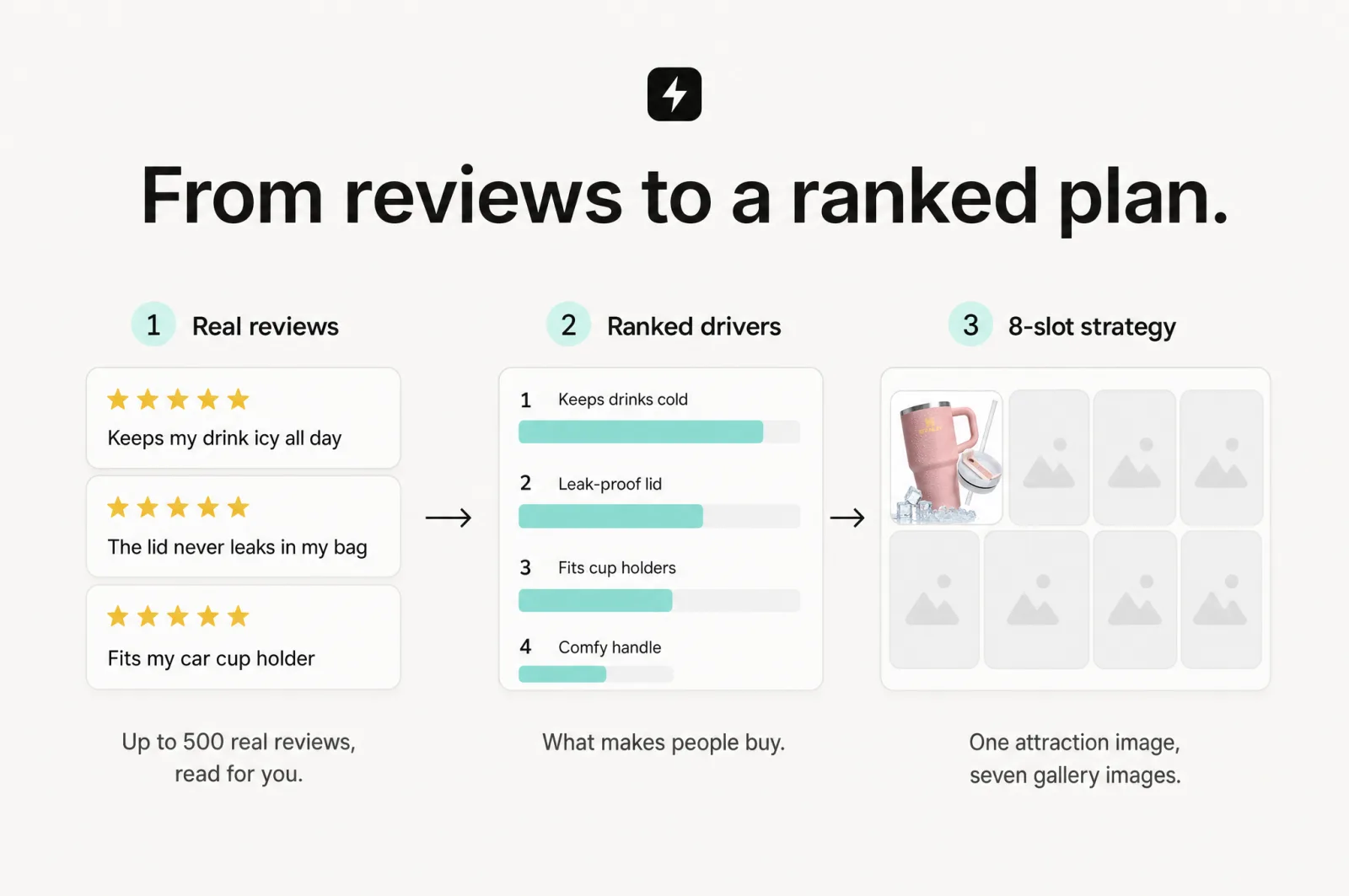
Scalable does not start with a blank canvas and a prompt box. It starts with your product. Paste one ASIN and it pulls the listing and up to 500 real customer reviews, then ranks the conversion drivers that make people buy and the communication gaps that silently block the sale. It scores every current image on both how it feels and how clearly it argues, benchmarked against the category leaders. It even estimates the conversion lift on the table, drawn from your own audit and gap data, so "will it convert" stops being a hope.
Then it turns that intelligence into a plan. Every listing gets an 8-slot content strategy: one attraction image built to win the click, then seven gallery images that carry the sales pitch in the order a shopper decides, with the on-image copy written in your customers' own language. You never face a blank canvas, and you never write a prompt.
That is the difference in one line. A model renders what you describe. This is AI product photography that decides what to make first, based on what your market already told you.
The same engine, minus the prompting
Now for the part that makes this comparison honest rather than convenient.
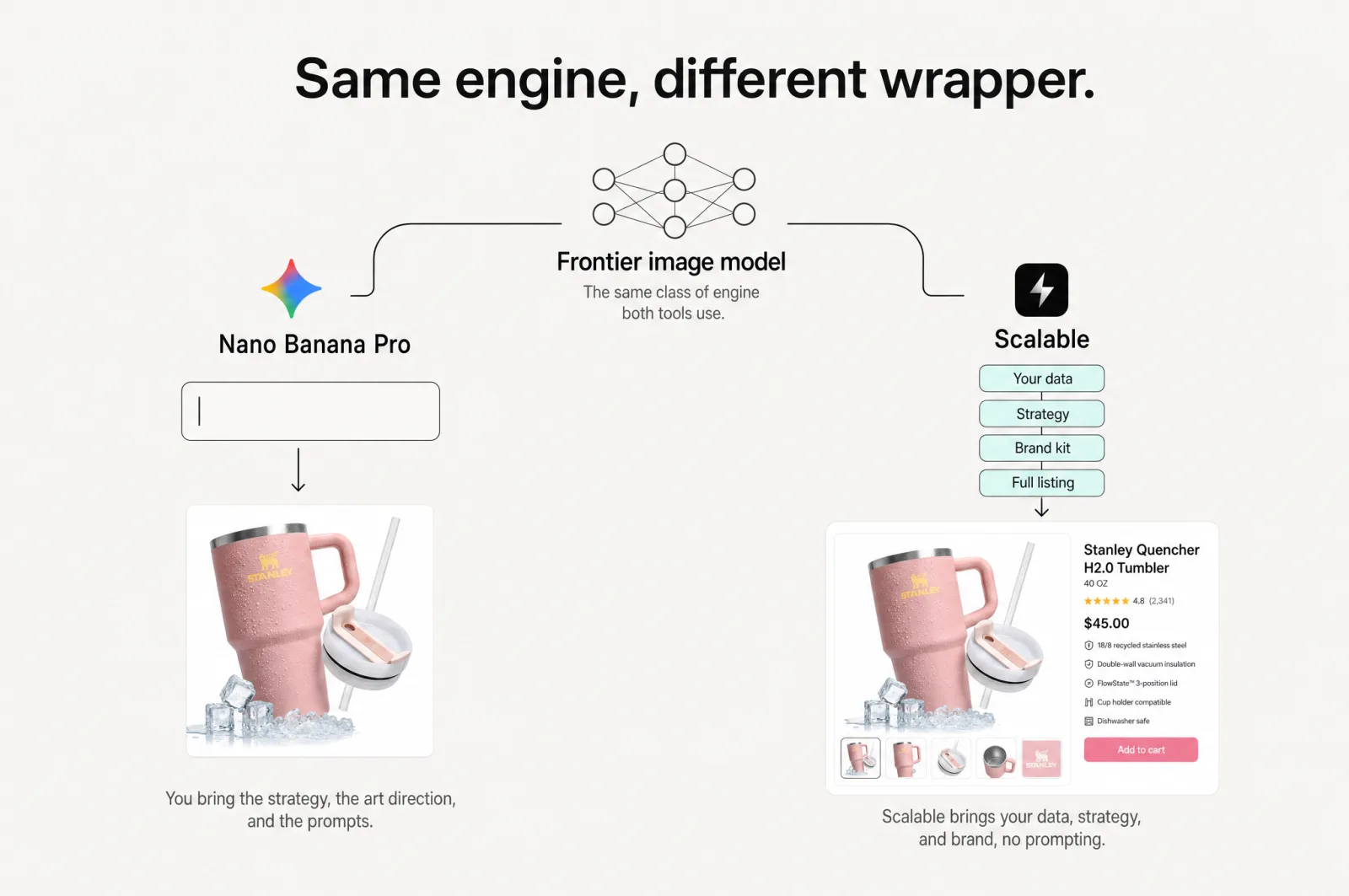
You might expect a company like ours to argue that its picture quality beats Google's. We will not, because the premise is wrong. Scalable generates on the latest frontier image models from OpenAI and Google, with a toggle to switch between them per generation. The technology under the hood is the same class of engine that powers tools like Nano Banana Pro.
Read that again, because it reframes everything. The model is not the moat. It is a commodity you can rent, and we rent the best of them. What you cannot rent from a prompt box is the strategy, the product knowledge, and the workflow wrapped around that engine.
So the choice is not "Scalable's model or Google's." It is a blank prompt box versus a system that already knows your product and does the thinking for you. One asks you to be an expert. The other makes the expertise unnecessary.
Premium and on-brand, every single time
A raw model forgets your brand the moment the next prompt starts. You can feed it a reference and cross your fingers, but nothing enforces your colors, type, and look across a hundred product photos and a growing catalog.
Scalable locks it in. Upload a few brand assets once and it builds a brand kit with three finished directions in about 6 min: a strict matched version, a polished uplift, and a bolder reimagining. Attach the kit and every asset after it inherits that identity. Agencies get a separate kit per client, so nobody's look bleeds into anybody else's. The result is cohesive, premium, the opposite of generic AI output.
And when a generation lands 95% right, you do not re-roll and pray. You fix the last 5% surgically: sharpen blurry text, erase a stray prop, swap the product into a scene you already love, recompose the frame into a new aspect ratio. That control is exactly where a prompt-only tool leaves you stuck.
One image versus your whole catalog
This is the gap that scales.
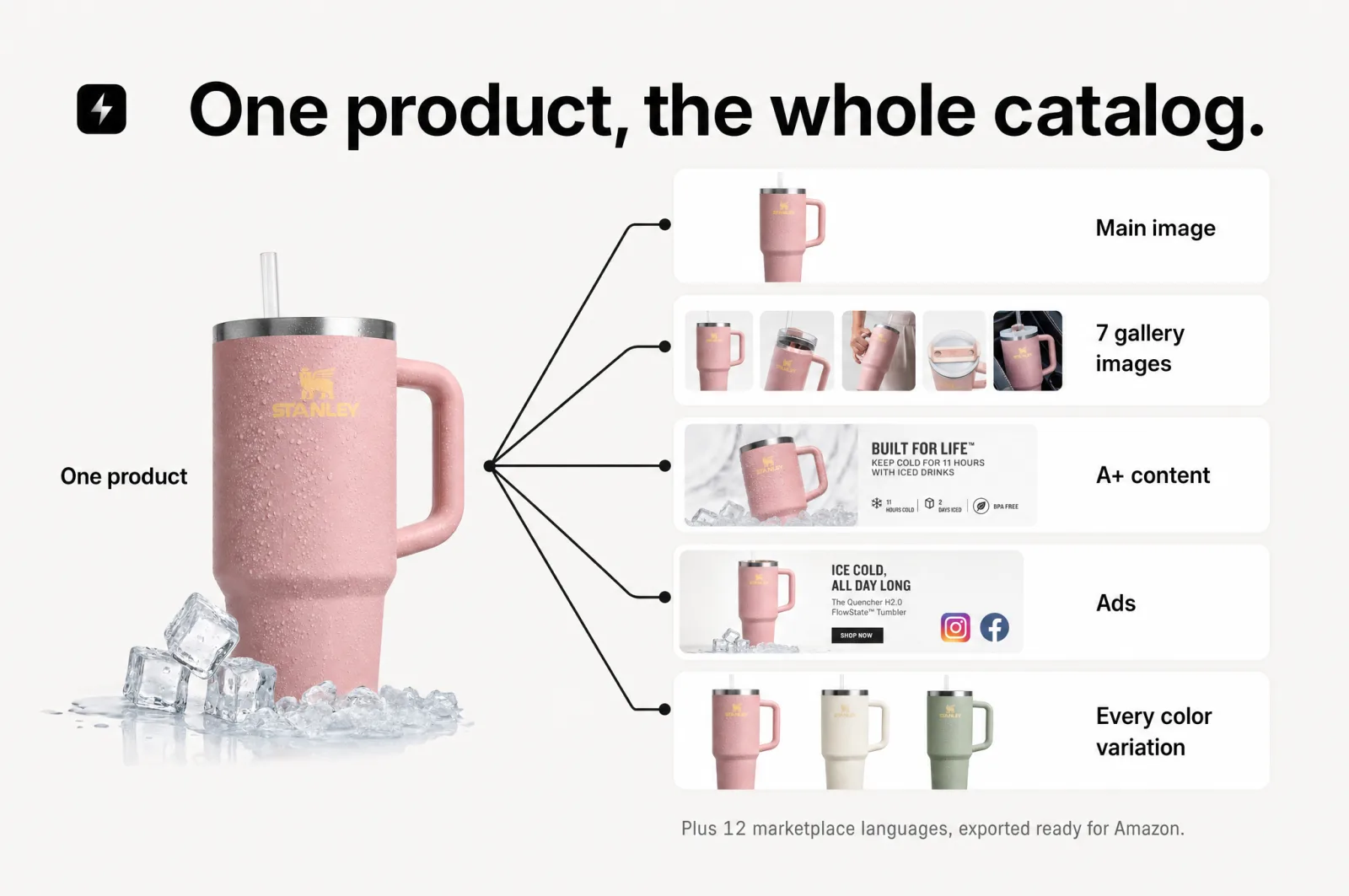
Nano Banana Pro gives you a picture. A single listing is a set of them, and a catalog stacks up a hundred. With Scalable, one product becomes the full stack: the main image, seven gallery slots, A+ content, and matching ads, produced as one flow. Add a color or a size and variations regenerate the whole set for every child SKU, named and zipped for Amazon upload. Expand to a new marketplace and every on-image word re-renders into up to 12 languages, keeping the meaning, not just swapping the words.
Doing that with a raw model means prompting each frame, for each variant, in each language, and holding the brand together across all of it by willpower. That is not a workflow. It is a second job.
Side by side: when to reach for which
An honest comparison ends with an honest recommendation, including when to skip us.
| What you need | Nano Banana Pro | Scalable |
|---|---|---|
| A one-off image, poster, or infographic | Excellent, fast, cheap | Overkill |
| Best-in-class in-image text | Its standout strength | Strong, plus text editing tools |
| Images built on your real reviews and market | Not its job | The core of the product |
| A conversion strategy per listing slot | You supply it | Built in, from your data |
| No prompting or design skill required | Prompting is the skill | Zero skills, plain language |
| Brand consistency across a catalog | Reference images only | Brand kits lock it everywhere |
| Full listing: main, gallery, A+, ads | One image at a time | One flow, every asset |
| Variations and 12-language localization | Manual, image by image | Automated, catalog-wide |
The pattern is clear once you see it. Reach for Nano Banana Pro when you want a beautiful image and you are happy to direct it. Reach for Scalable when you want a listing that converts, on brand, across every slot, SKU, and marketplace, without becoming a prompt engineer to get there.
Weigh the real cost, too. The old way of getting there ran $150 to $500 per listing with a freelancer over several days, or thousands with an agency over weeks. Scalable starts free: your first product analysis and your first brand kit cost nothing, so you can see the difference before you pay for it. This is Amazon product photography you own, not a service you wait on.
The two tools are not rivals in the usual sense. One is a brilliant engine. The other is everything that turns an engine into sales.
The real question is not which model. It is who does the thinking.
If you take one idea from this, take this: the moment image models became this good was the moment the model stopped being your problem. Beautiful is now cheap and available to everyone, including your competitors. The advantage moved to what you do with it, and that means strategy, product knowledge, and consistency at scale.
That is the shift worth making. From prompt-roulette, where you hope the pretty picture happens to sell, to owning an ecommerce product photography system built to convert. More than 7,500 brands and agencies already run their content this way, generating over 127k assets a month. You do not have to take our word for it.
Add your first product to Scalable free. Watch the same class of engine that impressed you turn your real reviews into a first set of main and gallery images, on your brand, designed to sell. Your first product analysis, your first brand kit, and that opening stack cost nothing, so the only thing you risk is finding out how much of the work you no longer have to do.
Frequently asked questions
- Is Nano Banana Pro good for Amazon product listings?
Nano Banana Pro makes gorgeous, high-resolution images with excellent in-image text, so it is great for one-off creative. It has no knowledge of your reviews, competitors, or conversion blockers, and no listing workflow, so you supply all the strategy, prompting, and art direction. For a listing built to convert, a data-driven platform does the thinking the raw model cannot.
- Do I still need a tool like Scalable if I already have Gemini or Nano Banana Pro?
If you only need occasional images and enjoy directing them, the raw model is enough. If you want listings that convert across a catalog, yes. Scalable runs the same class of frontier model but adds your product data, a conversion strategy, brand consistency, and full-listing output, with no prompting. The model is the easy part; everything around it is the work.
- What is the difference between an AI image generator and an AI product-content platform?
An AI image generator turns a prompt into a picture. An AI product-content platform turns your product's real data into a strategy, then generates every asset the listing needs, on brand, in the right format. The generator makes files. The platform makes a listing designed to sell.
Sources
- 1.Introducing Nano Banana Pro (Google DeepMind)
- 2.Gemini API image generation docs (Google)
- 3.Nano Banana Pro / Gemini 3 Pro Image API pricing breakdown
- 4.Amazon listing translation isn't enough: how to localize a listing that sells abroad
- 5.8 Amazon listing images, 8 jobs: 1 wins the click, 7 win the sale
Built by someone who’s lived it.
I’ve been in e-commerce since 2018. I built and exited my own brand, then spent 5+ years running a creative agency for product companies, shipping the listings, ads, and content that move real sales.
Filed under
Launch your full Amazon listing in minutes, in-house and on-brand
Main image, gallery, A+, ads, translations and variations. Built on your reviews, optimized for conversion.
Next recommended read
Amazon listing translation isn't enough: how to localize a listing that sells abroad
Amazon listing translation is localization, not word-swapping: the checklist to make your listing convert in every marketplace and language, not just read right.
7 min read
More on this topic — playbooks and product deep-dives.

8 Amazon listing images, 8 jobs: 1 wins the click, 7 win the sale
Your Amazon listing is not one hero image. It is 8 Amazon listing images doing 8 jobs: 1 wins the click, 7 win the sale. Here is the blueprint.

Design for the Amazon thumbnail: listing images that still sell on a phone
Most shoppers meet your listing as a tiny Amazon thumbnail on a phone. 5 rules for listing images that stay legible and sell at small size.

The Q4 catalog refresh: Amazon listing optimization for peak season without a photoshoot
Amazon listing optimization for Q4: refresh every listing for Prime Day and BFCM without a photoshoot. What to change, what to leave, and a dated plan.