

Jacob Jan Founder, Scalable
Writes about commerce AI and creative operations.
AI & regulation
The EU AI Act and ecommerce: what you actually have to do about AI content
A calm, sourced map of what the law asks of brands that make product content with AI, and what it doesn't.
TLDR
- You heard the EU AI Act is here, and part of you wonders if the AI making your product images is suddenly a liability.
- It isn't. The law is risk-based, and making marketing content sits at the calm end of it.
- Your real job is small and doable: be able to say what's AI-made, keep it honest, and keep a person in charge.
- Here's the plain-English map, with every date and rule linked to its official source.
The EU AI Act and ecommerce: what you actually have to do about AI content
Disclaimer: this article is general information about the EU AI Act as of 2026, not legal advice. It is not a substitute for advice from a qualified lawyer, does not create a lawyer-client relationship, and may not reflect later amendments or how the law applies to your specific products, market, or situation. Where a decision carries real risk, verify against the official sources linked throughout and consult professional counsel before acting.
You generate a product image with AI on a Tuesday. By Friday a LinkedIn post tells you the EU AI Act carries fines of tens of millions, and a forum thread swears AI content is about to be banned in Europe. So you pause the workflow you rely on and wait for someone to tell you it's safe.
That pause is the real cost. Not the law. The fear around the law.
Here is the calm version. The EU AI Act does not stop ecommerce brands from using AI to create product content. For most of us the duties are narrow and practical: be transparent about AI-generated content, and use it responsibly.
This guide walks the law the way it applies to a brand that makes listings, ads, and images, with every claim linked to an official source. It is not legal advice, and we will come back to that. It is a map.
Does the EU AI Act ban AI-generated product images?
Quick answer
No. Using AI for product content is legal in the EU; the duty is disclosure, not a ban. The EU AI Act is risk-based, and generating marketing content is not on its high-risk list. It is a low-risk activity that carries light transparency duties. Your practical obligations are to disclose AI-generated content where the rules require it and to represent your product honestly, both of which you can meet without slowing down.
The EU AI Act in one minute
The EU AI Act is the world's first comprehensive law on artificial intelligence, and the single most useful thing to understand about it is its shape: it is risk-based [1]. The rules you face scale with how risky the use of AI is, not with the fact that you use AI at all. Formally, it is Regulation (EU) 2024/1689 [2].
It entered into force on 1 August 2024 and has been broadly applicable since 2 August 2026, with different obligations switching on in stages along the way [1]. So "the AI Act" is not a single switch that flipped. It is a schedule, and where you sit on it depends on what you do with AI.
For an ecommerce brand, that risk-based design is the whole story. The heavy obligations were written for AI that decides things about people: who gets hired, who gets a loan, how law enforcement acts.
Generating a gallery image for a water bottle is a different universe from that, and the law treats it that way. The next 2 sections show exactly where your work lands and the one duty that genuinely touches it.
Where your product content falls
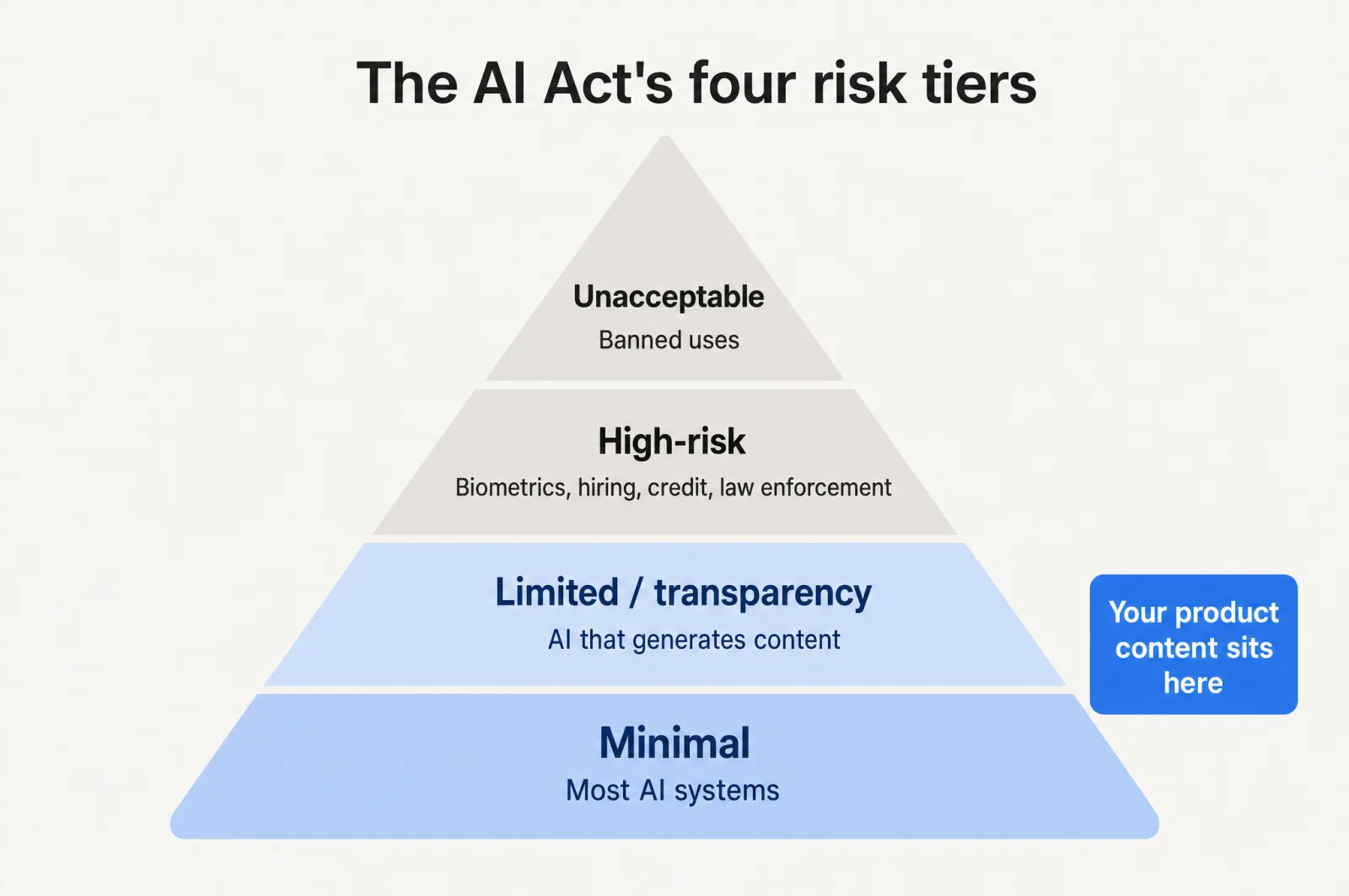
The Act sorts AI into 4 levels of risk [1]:
| Risk level | What sits here | What it means for you |
|---|---|---|
| Unacceptable | Banned uses (social scoring, manipulative or exploitative AI) | Not you |
| High | Biometrics, critical infrastructure, hiring, credit, law enforcement, migration, justice | Not you |
| Limited / transparency | AI that talks to people or generates content | This is your tier |
| Minimal or no risk | The vast majority of AI systems | Also you, for most tasks |
Generating marketing images and copy is not on the high-risk list [1]. That tier is defined by use case: an AI system lands there when it is pointed at something like screening job applicants, not when it renders a product photo. Making listing content lives in the transparency tier, with a light duty we will cover next, and often in the minimal-risk bucket that the Commission says covers most AI in use today [1].
This is also where that scary fine number belongs. The Act's top penalty, up to €35M or 7% of worldwide annual turnover, applies to the banned uses in the unacceptable tier [3]. It was never aimed at a brand making a product image.
Other obligations, including the transparency rules that could touch you, sit in a lower band of up to €15M or 3% [3]. Smaller companies are capped at the lower of the fixed amount or the percentage, not the higher [3].
The headline figure you saw is real. It just isn't yours.
The part that touches you most: transparency
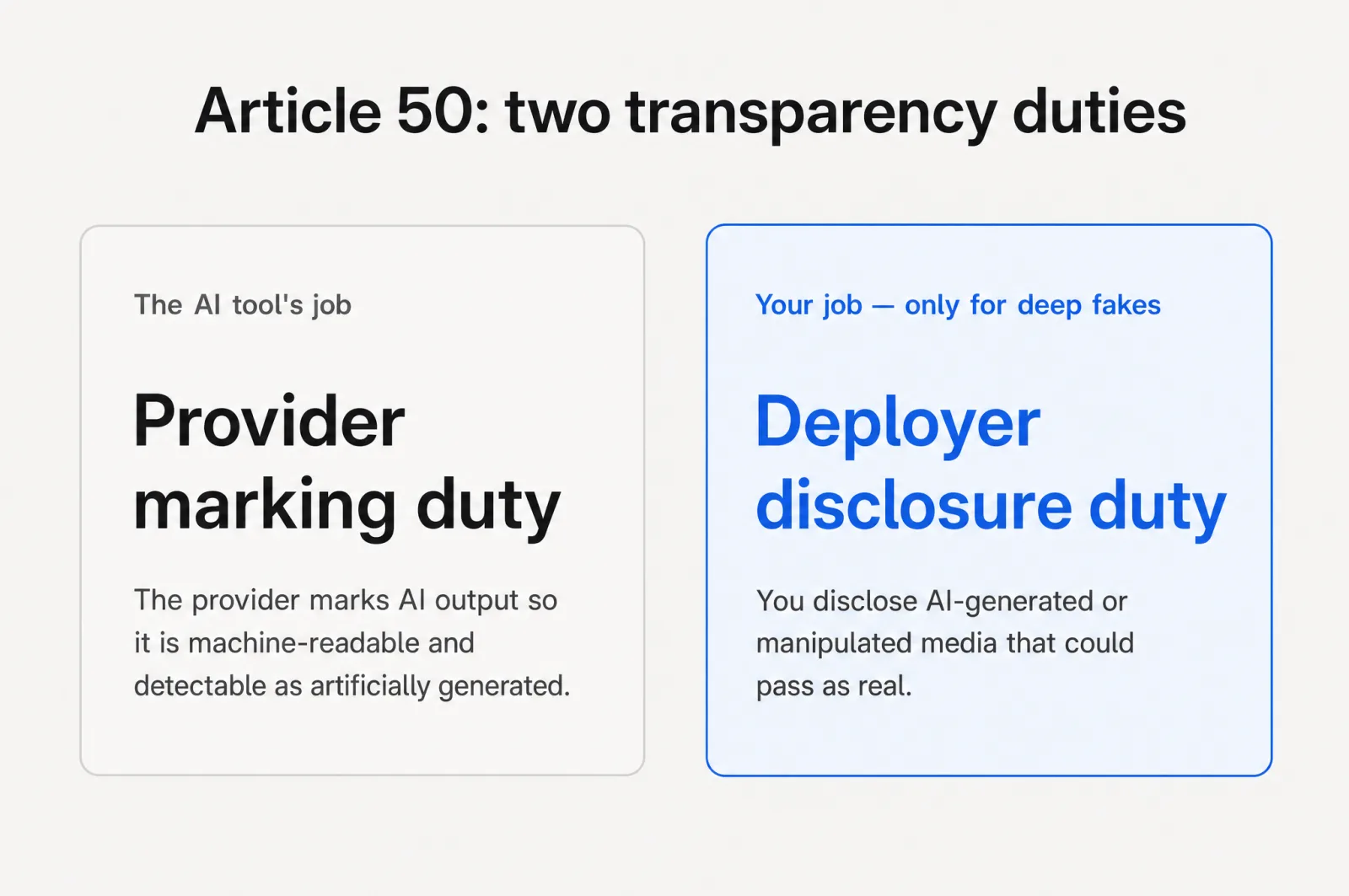
Here is the one section to read twice. The obligation most likely to apply to AI-made product content is transparency, set out in Article 50 of the Act [4]. It comes in 2 parts, and the difference matters.
The first part is a marking duty. Providers of AI systems that generate synthetic image, audio, video, or text must mark the output so it is machine-readable and detectable as artificially generated [4].
Read that word carefully: providers. That duty sits with the company that builds the AI tool, not with you as the brand using it. It is one reason the tool you choose matters, a point we will return to.
The second part is a disclosure duty, and this one can land on you. If you deploy AI to produce content that is a deep fake, you have to disclose that it was artificially generated or manipulated [4].
In plain terms, a deepfake is fake content built to pass as real. The legal definition is narrower and worth reading closely: AI-generated or manipulated image, audio, or video that resembles real persons, objects, places, or events and would falsely appear to be authentic [5].
Run your own content through that test. A clean, stylized render of your product on a colored background is a weak fit: nobody mistakes it for an unaltered photo of a real scene, and it shows your actual product. An AI image of a realistic-looking person holding it, a fabricated "customer," or a scene staged to pass as a genuine photo sits much closer to the line, and that is where a disclosure makes sense.
For the in-between cases, the boundary is fact-specific and still settling. When an image could plausibly pass as real, a light "AI-generated" note is the low-cost, safe call. For text, the duty is narrower still: it applies to content published to inform the public on matters of public interest, not ordinary product descriptions, and it falls away when a person holds editorial responsibility for the copy [4].
Don't forget the laws you already have
Now the part most AI-Act coverage skips. The biggest legal risk in your product content probably has nothing to do with this law at all. It is the consumer-protection rulebook that has governed advertising for 2 decades.
The Unfair Commercial Practices Directive, Directive 2005/29/EC, already bans misleading commercial practices across the EU [6]. Something crosses that line if it carries false information or, through its overall presentation, deceives the average consumer into a buying decision they would not otherwise make [6].
The rule is technology-neutral. It does not care whether an image came from a camera, a designer, or a model. It cares whether it tells the truth.
So the practical risk is not "we used AI." It is "the picture shows a feature the product doesn't have," or "the scale looks twice life-size," or "the color is nothing like what ships." Those were problems long before AI, which now makes them easier to create by accident, since a flattering-but-wrong image takes seconds to generate.
The duty is the same one you always had: your content must represent the real product. Keep it honest and this law stays quiet, exactly as it did before.
The timeline that matters to you
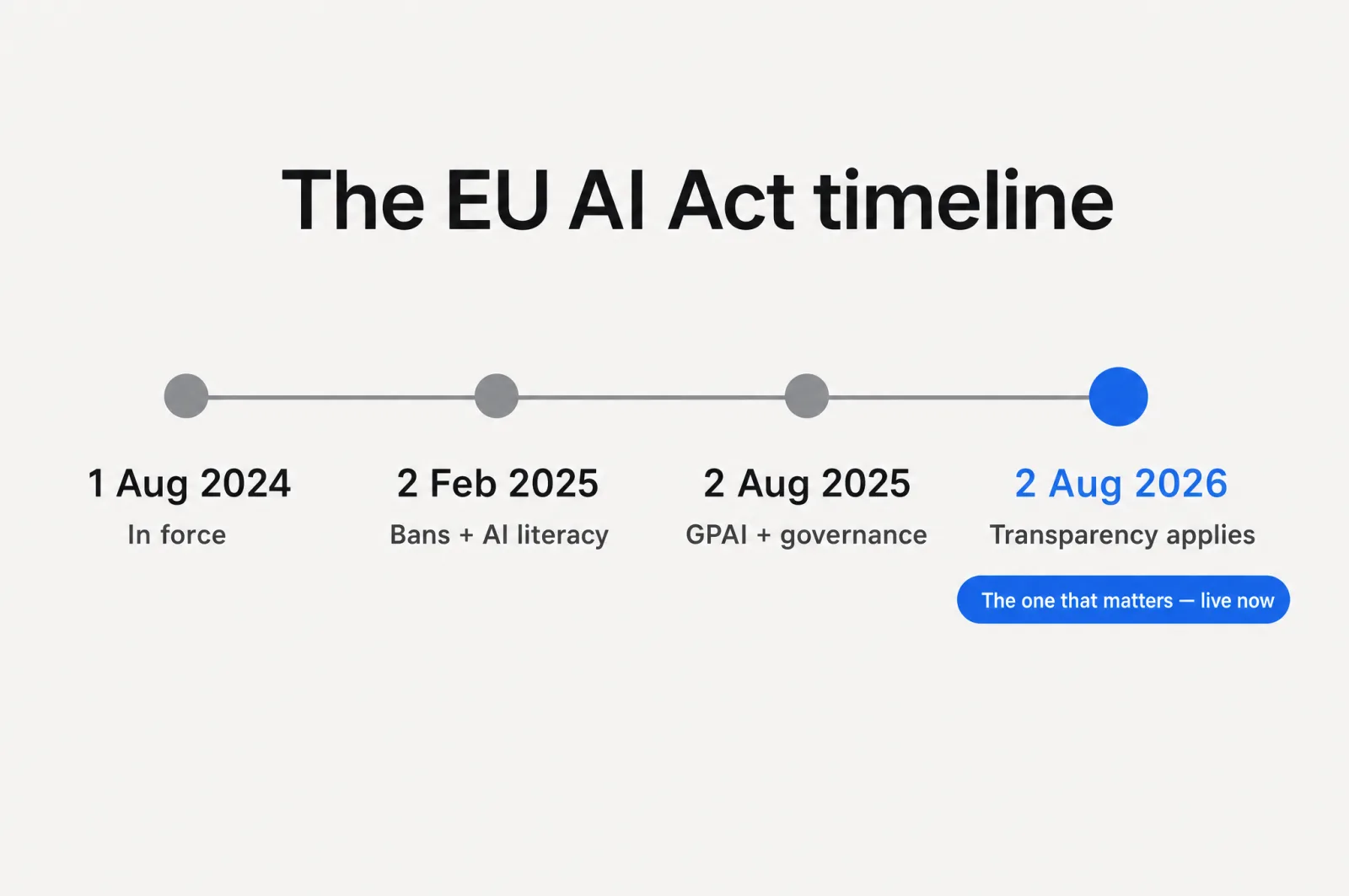
You do not need the full legislative calendar. You need to track 4 dates, and in truth only 1 of them matters [7]:
| Date | What starts | Relevant to you? |
|---|---|---|
| 1 Aug 2024 | The Act enters into force | Background |
| 2 Feb 2025 | Bans on unacceptable-risk AI, AI-literacy duties | Rarely |
| 2 Aug 2025 | Rules for general-purpose AI models and governance | Your tool vendor's concern |
| 2 Aug 2026 | The transparency rules apply | Live now, your one to know |
The one that matters is 2 August 2026, when the transparency obligations in Article 50 started to apply [7]. As of 2026 they are already in effect, so this is not a future cliff to brace for. It is the standard your disclosure habit already needs to meet.
The high-risk rules run on a later and, as of 2026, still-shifting schedule, but those govern the hiring-and-credit tier, not product content, so you can let them pass. The practical takeaway stays calm: have a simple disclosure habit running now, and you are current.
A practical checklist for ecommerce brands
None of this requires a lawyer on retainer or a slowdown in how you ship. It requires a handful of habits a non-specialist operator can adopt this week.
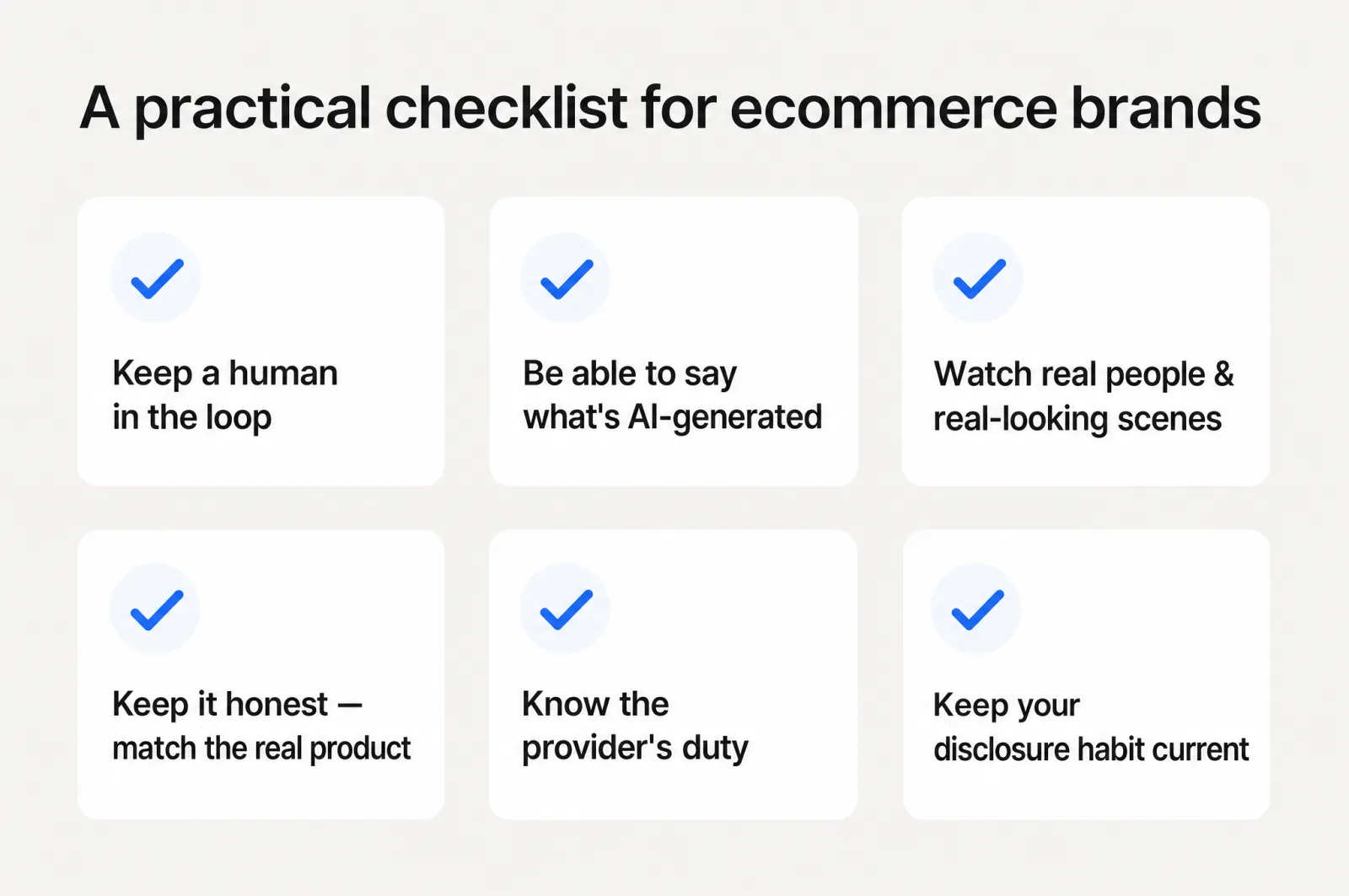
- Keep a human in the loop. Review every AI-made asset before it goes live. A person deciding what publishes is both good practice and quietly resolves most of the edge cases above.
- Be able to say what's AI-generated. You don't need a public label on everything. You do need a simple internal record of which assets are AI-made, so you can disclose when a specific image warrants it. Across a bigger catalog, make that a lightweight process, not something you hold in your head.
- Watch real people and real-looking scenes. That is where the disclosure duty bites. Synthetic humans, fabricated testimonials, and photo-realistic staged scenes get a clear "AI-generated" note.
- Keep it honest. The image must match the real product: right features, right scale, right color. This is the old consumer-protection duty, and it carries most of your real risk.
- Know where the provider's duty sits. The machine-readable marking obligation falls on whoever builds the AI system, not on you. When you choose a tool, favor one that takes transparency seriously and keeps you in control of what you make.
- Keep your disclosure habit current. The transparency rules are already in effect as of 2026, so keep the habit running and revisit it as official guidance lands. Don't freeze the workflow while you wait for perfect clarity.
Do these 6 things and you are meeting the AI Act where it touches you, without a single day lost to the fog.
Use AI responsibly, don't avoid it
The brands that win the next few years won't be the ones that stopped using AI out of caution. They will be the ones that used it responsibly: content they own, made honestly, with a person in control.
Responsible use isn't a tax on speed. It lets you keep moving while others sit frozen, waiting for permission that was never required.
That is the lens we build in. Scalable is an AI content platform for ecommerce, and it is deliberately not a black box: a person stays in control of what goes out the door, and you own the content you create. You can review and refine every asset before it publishes, which is the same instinct this whole guide points to.
Important
This article is general information, not legal advice, and the law is still settling as of 2026. It does not make you, or any tool, "AI-Act compliant," and no software can promise that. For how these rules apply to your specific products and market, talk to a qualified lawyer.
Keep creating. Stay in control of what you make, and keep it honest and yours. That is the whole job, and you can start today, free.
Frequently asked questions
- Does the EU AI Act ban AI-generated product images?
No. The AI Act is risk-based, and generating marketing content is not on its high-risk list. Using AI to make product images or copy is treated as a low-risk activity with light transparency duties, not a banned or high-risk one. You can keep using AI for product content. The practical duties are about disclosure and honest representation, not a ban.
- Do I have to label my product images as AI-generated?
It depends on the image. The law's marking duty falls mainly on the AI tool's provider, not on you. Your own disclosure duty bites when content is a deep fake, meaning it would pass as an authentic photo of real people, places, or events. A stylized render of your own product is a weak fit. An AI image of a real-looking person is much closer.
- Which EU AI Act deadline matters most for ecommerce?
2 August 2026, when the transparency rules started to apply. That is the date the disclosure obligations around AI-generated content took effect. The law entered into force on 1 August 2024 and phases in over several years. As of 2026 the transparency rules are already live, so for a brand using AI for product content, the disclosure habit is something to have running now, not a date still ahead.
Sources
- 1.European Commission: AI Act (regulatory framework)
- 2.EUR-Lex: Regulation (EU) 2024/1689 (the AI Act)
- 3.EU AI Act, Article 99 (penalties)
- 4.EU AI Act, Article 50 (transparency obligations)
- 5.EU AI Act, Article 3 (definitions, 'deep fake')
- 6.Unfair Commercial Practices Directive 2005/29/EC (EUR-Lex)
- 7.EU AI Act: implementation timeline
- 8.Stop gambling on your Amazon listing
- 9.Do you have to label AI-generated product images?
Built by someone who’s lived it.
I’ve been in e-commerce since 2018. I built and exited my own brand, then spent 5+ years running a creative agency for product companies, shipping the listings, ads, and content that move real sales.
Filed under
Launch your full Amazon listing in minutes, in-house and on-brand
Main image, gallery, A+, ads, translations and variations. Built on your reviews, optimized for conversion.
Next recommended read
Stop gambling on your Amazon listing
Amazon listing optimization is sold as a blind bet: pay, wait weeks, hope it converts. Here is how to own your listing content and see the result first.
9 min read
More on this topic — playbooks and product deep-dives.

Do you have to label AI-generated product images?
Do you have to label AI-generated product images? A calm, sourced answer, plus what Amazon, Meta, TikTok, and the EU AI Act require of your images.

Design for the Amazon thumbnail: listing images that still sell on a phone
Most shoppers meet your listing as a tiny Amazon thumbnail on a phone. 5 rules for listing images that stay legible and sell at small size.

The Q4 catalog refresh: Amazon listing optimization for peak season without a photoshoot
Amazon listing optimization for Q4: refresh every listing for Prime Day and BFCM without a photoshoot. What to change, what to leave, and a dated plan.