

Jacob Jan Founder, Scalable
Writes about commerce AI and creative operations.
AI & regulation
Do you have to label AI-generated product images?
The honest answer, plus what Amazon, Meta, TikTok, and the EU AI Act ask of your images.
TLDR
- A headline said the EU AI Act carries fines in the tens of millions, so you paused the AI that makes your product images and waited for someone to tell you it's safe.
- That pause is the real cost, not the rule. The honest answer is smaller and calmer than the headline made it sound.
- You rarely have to stamp a label on your own product photos. The marking duty sits with the tool, and the real risk is a misleading image, not an AI one.
- Here is the plain map of what the law and each marketplace ask, every rule linked to its source, with a 5-point checklist you can run this week.
Do you have to label AI-generated product images?
Quick answer
Usually not on your own product photos. The EU AI Act's machine-readable marking duty falls on the AI tool's provider, not on you [1]. Your own disclosure duty applies only when an image is a deep fake, a synthetic scene built to pass as real [2]. A clean render of the product you ship is a weak fit. The rules more likely to touch your day are the marketplaces' own AI policies, which are often stricter and sooner than the law.
You generate a product image with AI on a Tuesday. By Friday a post warns you the fines run to tens of millions of euros, and a forum swears AI images are about to be banned in Europe. So you freeze the workflow you rely on and wait for permission that, it turns out, was never required.
Let's take the fear apart calmly. The answer breaks into 3 questions: what the law asks of you, where the real risk sits, and what each marketplace requires. None of them ends where the headline pointed.
What the EU AI Act asks of you, versus your tool
Start with the scary number, because it is the easiest part to put down. The Act is risk-based: the rules scale with how risky the use of AI is, not with the fact that you used AI at all [3]. Making product content sits in its light transparency tier, not the banned tier that carries the top penalty of €35M or 7% of worldwide turnover [4].
The transparency duties sit in a lower band, up to €15M or 3%, and smaller companies are capped at the lower of the 2 figures [4]. The headline number is real. It was never pointed at a brand making a product image.
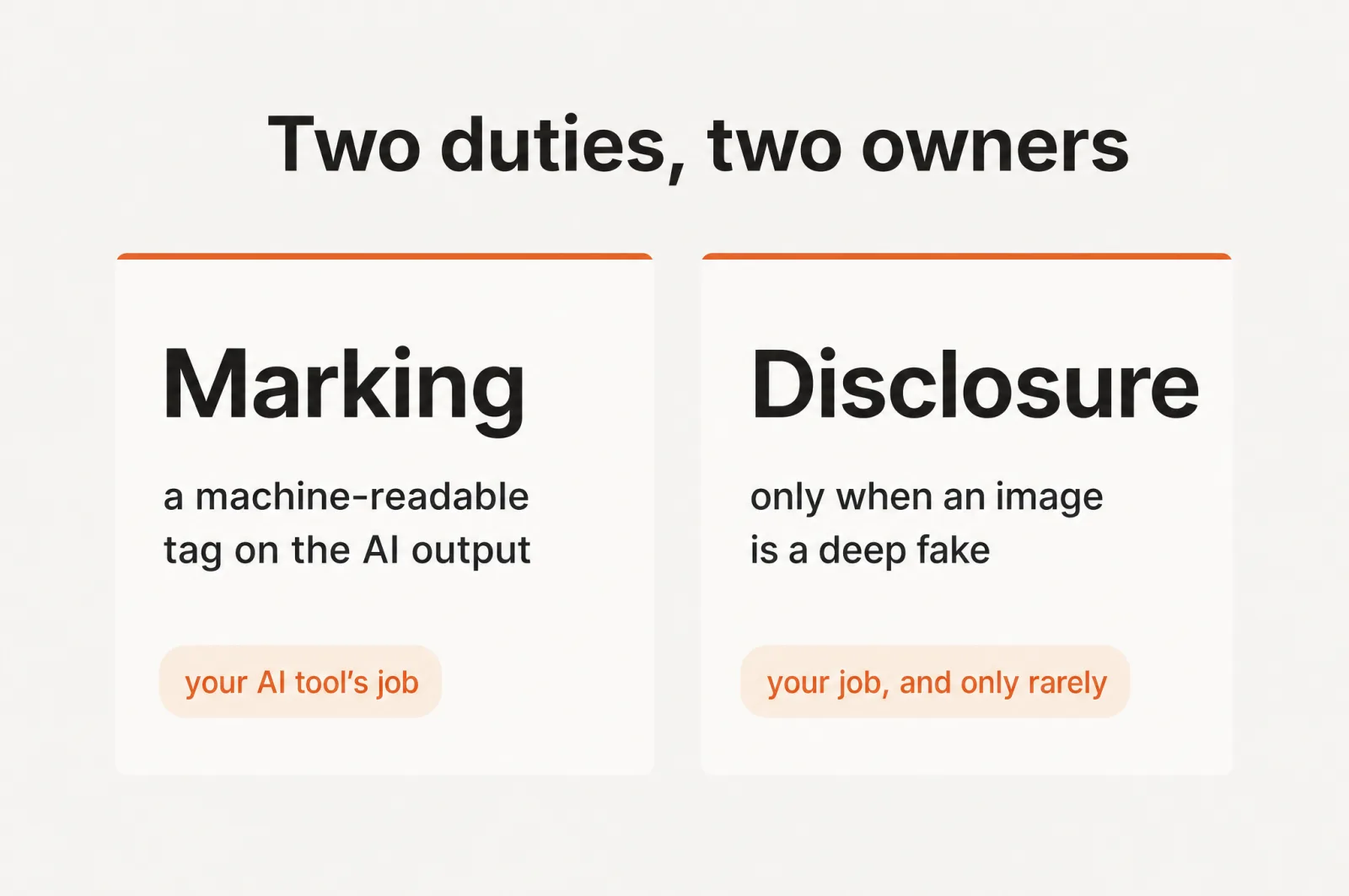
Now the duty itself. Article 50 splits into 2 parts, and the split is the whole point [1].
The first is a marking duty. Providers of AI systems that generate synthetic image, audio, video, or text have to mark the output so a machine can read it as artificially generated [1]. Read that word twice: providers. That duty sits with the company that builds the AI tool, not with you as the brand using it. A good tool carries it for you: Scalable signs your image exports with C2PA Content Credentials that mark them as AI-generated, the disclosure the EU AI Act and Amazon expect.
The second is a disclosure duty, and this one can reach you, but only in a narrow case. If you deploy AI to make content that is a deep fake, you have to disclose that it was artificially generated [1]. In law a deep fake is AI-generated or manipulated content that resembles real people, places, or events and would falsely appear authentic [2].
So run your own images through that test. A stylized render of your own bottle on a colored background is a weak fit: it shows your real product and nobody mistakes it for an unaltered photo.
The clearest trigger for your own disclosure duty is an AI-generated or altered person. Think a synthetic "customer," a model who never existed, a face built to look real. The moment an image puts a lifelike figure who isn't real in front of the shopper, that is a deep fake, and you disclose it. A scene staged to pass as a genuine photograph sits in the same territory.
If the worry underneath all this is that a label will scare shoppers off, breathe out. The clean product renders that make up most of a listing need no label at all. Where one does apply, it is a small "AI-generated" note on the odd synthetic image, not a badge across your catalog, so the conversion cost is close to nothing.
Two dates close the section. The transparency rules apply from 2 Aug 2026, so this is a standard to meet now, not a cliff ahead [3]. Generative systems already on the market before that date get until 2 Dec 2026 to meet the machine-readable marking, a short grace period granted by the May 2026 Digital Omnibus agreement [5]. That window is the tool's to use, not yours.
For the full risk-tier map and how the Act sits next to older consumer law, we wrote the big-picture guide separately: the EU AI Act and ecommerce. This post stays on the narrower question you came for: your images.
The line that decides everything: accurate versus deceptive
Here is the part most AI-Act coverage skips. Your biggest exposure in product imagery has almost nothing to do with this law. It is the consumer-protection rulebook that has governed advertising for 2 decades.
The Unfair Commercial Practices Directive already bans misleading commercial practices across the EU, and it is technology-neutral [6]. It does not care whether an image came from a camera, a designer, or a model. It cares whether the picture tells the truth.
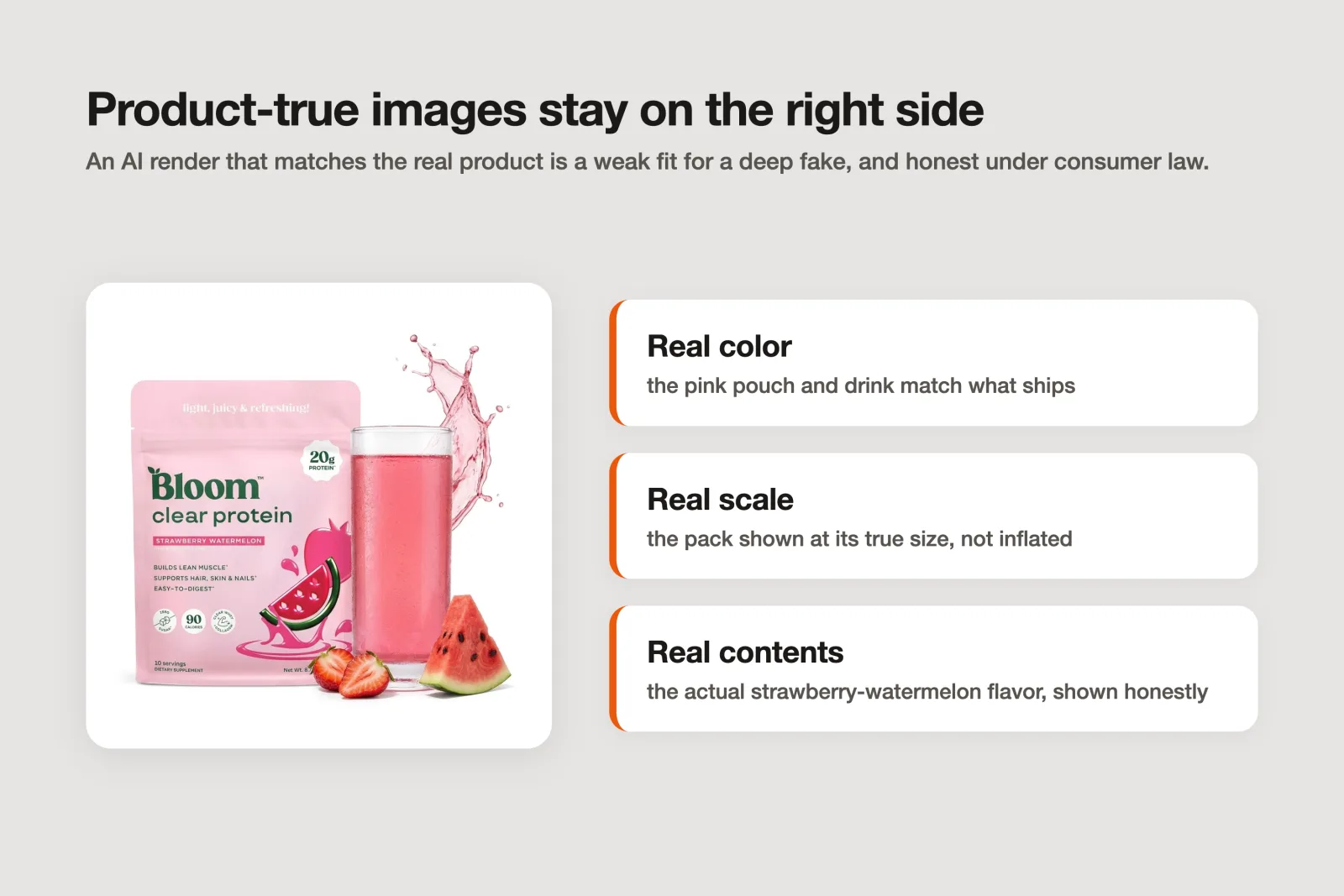
So the practical risk is not "we used AI." It is an image that shows a feature the product lacks, a scale twice life-size, or a color nothing like what ships. Those were problems long before AI, which now just makes the flattering-but-wrong version faster to create by accident.
Which means the decision that protects you is upstream of any label: how the image gets made. When generation is anchored to your real product, its true shape, color, and details, the picture stays honest by construction.
That is the idea behind building images on the item itself instead of a blank text prompt: the output looks like what you sell, in your world, not a convincing fiction of it. Keep the picture true to what you ship, and this old law stays quiet, exactly as it did before AI.
What the marketplaces and ad platforms actually require
The law is the floor. The rules you feel day to day belong to the platforms, and they tend to be stricter and to arrive sooner. Here is where the big 4 stand in 2026.
| Platform | Its AI-content rule | What it means for your images |
|---|---|---|
| Amazon | Permits AI-assisted and AI-generated imagery, but every image must accurately represent the product being sold [7] | The standing image spec still governs: real scale, real color, real contents. Amazon listing compliance here is about the product being true, not about the tool that drew it. |
| Meta ads | Applies an "AI info" label and reads industry provenance signals to detect AI content [8] | If your creative carries provenance metadata from an AI tool, Meta may label it for you. Disclosure, not a ban. Undisclosed AI in sensitive cases, like photorealistic people, is where rejection lives. |
| TikTok | Creators apply the AI-generated label for content that is fully AI or significantly AI-edited; TikTok auto-labels its own AI effects [9] | A product clip shot on a real camera generally needs no label. AI backgrounds, synthetic scenes, or a generated presenter do. |
| Google Ads | Discloses AI-made ads in its "how this ad was made" panel and requires disclosure of synthetic or altered media in election ads [10] | For an ordinary product ad the disclosure is largely automatic. The hard rule targets political and altered-people content, not a clean product render. |
Those provenance signals Meta reads are not magic. They are an open standard called C2PA, which lets a tool embed machine-readable "made with AI" data that platforms can detect [11]. It is the same mechanism the AI Act's marking duty points at, which is why the tool you generate with quietly decides how your content gets labeled downstream.
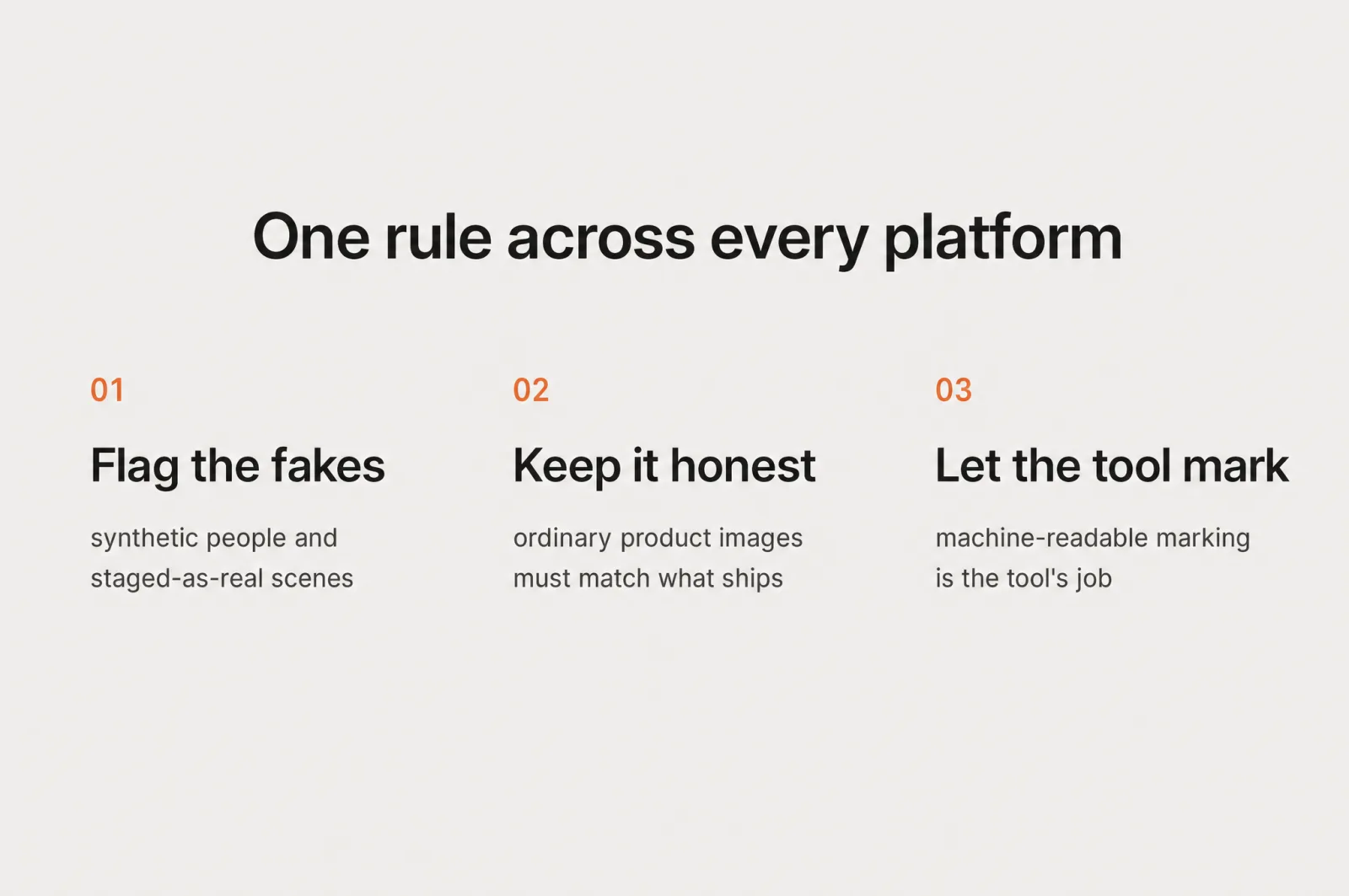
Read the 4 rows together and one pattern falls out. Every platform wants the same thing: flag synthetic humans and scenes staged to look real, keep ordinary product imagery honest, and let the tool handle the machine-level marking. Meet that, and you are inside all of them at once.
Your 5-point AI-image labeling checklist
None of this needs a lawyer on retainer or a slower workflow. It needs a handful of habits a non-specialist operator can adopt this week.
- Keep a human in the loop. Review every AI-made image before it goes live. One person deciding what publishes resolves most of the edge cases above; across a bigger catalog, make that a lightweight process, not something you hold in your head.
- Keep your images product-true. Right features, right scale, right color. This is the old consumer-protection duty, and it carries most of your real risk [6].
- Flag AI-generated people first, then staged-as-real scenes. A synthetic "customer" or a face edited to look real is the clearest case where your own disclosure duty applies [1]; a photo-real staged scene is close behind. Give each a clear "AI-generated" note.
- Use each platform's own label. Amazon accuracy, Meta's AI info, TikTok's toggle, Google's panel. Follow the house rules of wherever the image runs [7].
- Know your tool's duty, and pick a tool that takes it seriously. The machine-readable marking sits with whoever builds the AI [1]. Favor one that keeps you in control and generates from your real product, not from a blank prompt.
Do these 5 things and you are meeting both the law and the marketplaces where they touch you, without a day lost to the fog.
Build on the right side by default
The brands that pull ahead over the next few years will be the ones that used AI responsibly: content they own, made honestly, with a person in control.
That is the lens we build in. Scalable generates listing images anchored to your real product, so they look like what you ship, which is what keeps them honest.
On the provider side, the machine-marking is already handled for you: your exports ship signed with C2PA Content Credentials, the "made with AI" signal the EU AI Act and Amazon look for.
It also attaches Amazon's terms of service as a guardrail the moment you add a product. The marketplace's claim rules then ride inside the generation, not a checklist you run afterward. And when a synthetic element does need a visible note, you can add your own disclosure text to an image right in the editor.
The point is simple: Scalable gives you the tools to stay on the right side, and you decide when to apply them. You review and refine every asset before it publishes, and you own what you make.
Important
This article is general information about the EU AI Act and marketplace policies as of 2026, not legal advice, and the rules are still settling. It does not make you, or any tool, "AI-Act compliant," and no software can promise a marketplace's decision. For how these rules apply to your specific products and market, check the official sources linked throughout and talk to a qualified lawyer.
Keep creating. Keep your images true to the product, keep a person in charge, and the labeling question stops being scary and starts being a short checklist. You can begin today, free.
Frequently asked questions
- Do you have to label AI-generated product images?
Usually not on your own product photos. Under the EU AI Act the machine-readable marking duty falls on the AI tool's provider, not on the seller. Your own disclosure duty applies only when an image is a deep fake, a synthetic scene made to pass as real. A clean render of the product you ship is a weak fit, so a per-image label is rarely required of you by law.
- Does Amazon allow AI-generated product images?
Yes. Amazon permits AI-assisted and AI-generated listing imagery, but the normal image rules still govern. Every image has to accurately represent the product being sold, including its real scale, color, and contents. The risk is never that an image was made with AI; it is an image that misstates the product. Keep it true to what ships and you stay inside Amazon's rules.
- When does an AI product image count as a deep fake?
A deep fake, in the EU AI Act's sense, is AI-generated or manipulated content that resembles real people, places, or events and would falsely appear authentic. A stylized image of your own product is a weak fit. A fabricated customer, a fake testimonial, or a scene staged to pass as a real photograph sits much closer to the line, and that is where a clear AI-generated disclosure makes sense.
Sources
- 1.EU AI Act, Article 50 (transparency obligations)
- 2.EU AI Act, Article 3 (definitions, 'deep fake')
- 3.European Commission: AI Act regulatory framework
- 4.EU AI Act, Article 99 (penalties)
- 5.Gibson Dunn: EU AI Act Omnibus Agreement (postponed deadlines and key changes)
- 6.Unfair Commercial Practices Directive 2005/29/EC (EUR-Lex)
- 7.Amazon Seller Central: product image requirements
- 8.Meta Transparency Center: labeling AI content
- 9.TikTok: AI-generated content (Support)
- 10.Google Ads policy: political content and synthetic or altered media disclosure
- 11.Coalition for Content Provenance and Authenticity (C2PA)
- 12.The EU AI Act and ecommerce: what you actually have to do about AI content
- 13.Amazon main image requirements
Built by someone who’s lived it.
I’ve been in e-commerce since 2018. I built and exited my own brand, then spent 5+ years running a creative agency for product companies, shipping the listings, ads, and content that move real sales.
Filed under
Launch your full Amazon listing in minutes, in-house and on-brand
Main image, gallery, A+, ads, translations and variations. Built on your reviews, optimized for conversion.
Next recommended read
The EU AI Act and ecommerce: what you actually have to do about AI content
What the EU AI Act means for ecommerce brands using AI content: the transparency rule that matters, the 2026 timeline, and a plain checklist. Not legal advice.
10 min read
More on this topic — playbooks and product deep-dives.

Amazon main image requirements: stay compliant and still win the click
The Amazon main image requirements in full, plus how to lift click-through without breaking a rule or getting your listing suppressed.

How to keep a growing catalog on-brand with a brand kit generator
An inconsistent catalog leaks trust and sales. See how a brand kit generator locks your brand once so every listing stays on-brand as you scale.

Stop gambling on your Amazon listing
Amazon listing optimization is sold as a blind bet: pay, wait weeks, hope it converts. Here is how to own your listing content and see the result first.