

Jacob Jan Founder, Scalable
Writes about commerce AI and creative operations.
Ad creative
Why your best-clicking ad creative is quietly losing you money
Getting the click is the easy half. Here is how to build creative that pulls the right click, the one that turns into a sale.
TLDR
- You can pour money into ads and still watch the clicks lead nowhere, which feels like the budget is just leaking.
- The problem usually is not your targeting. It is the creative, and "get more clicks" is the wrong thing to chase.
- The creative that wins pulls the right click: it stops the scroll and pre-sells the shopper who was going to buy.
- Here are the 5 rules of a click-earning creative, and how to build one from your own buyer data.
What makes an ad creative people click?
Quick answer
An AI ad creative earns the click when it lands one clear message in about a second: a single outcome the shopper wants, with the product in the first frame and legible at a glance. Winning the click is only the start. The creative that pays off also pre-sells the right buyer, so the click turns into a sale instead of wasted spend. Build it from real buyer data, not guesses, and both jobs get easier at once.
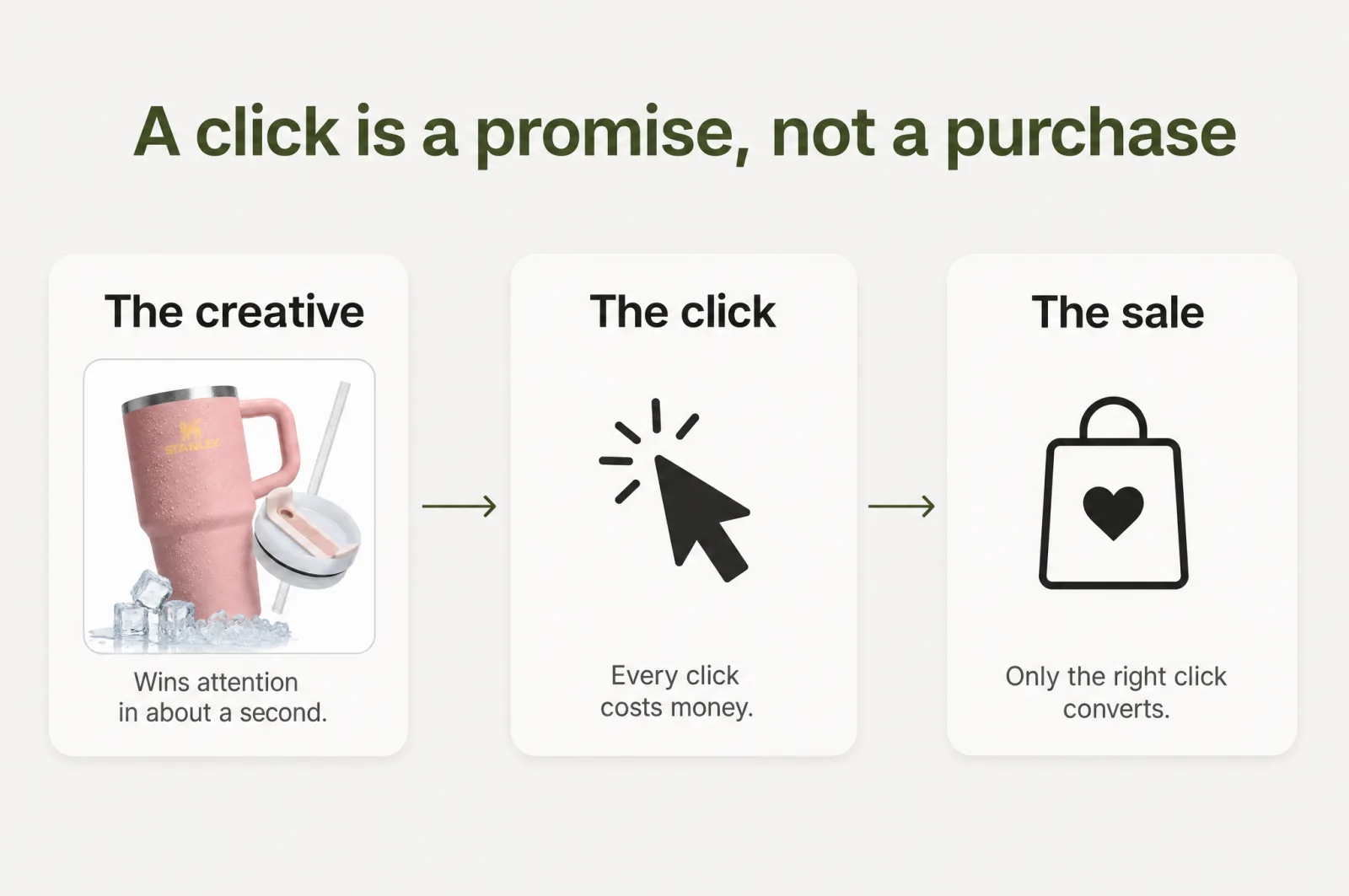
The click is only half the job
The most-clicked ad in your account might be the worst one you run. Whether you generate an AI ad creative for a Meta feed or design an Amazon main image, the same trap catches everyone: chasing clicks instead of customers.
A click is a promise, not a purchase. You pay for the click. You profit from the sale.
And most clicks never become sales. Even on high-intent paid search, the average landing page converts around 11%, so nearly 9 in 10 clicks walk away [1].
So raw click-through is the wrong number to optimize. A creative can win the scroll with a bright badge or a curiosity gap, pull a flood of clicks, and send you shoppers who were never going to buy. The spend is real. The sales are not.
If you run ads for clients, this is the argument you have been missing. When the clicks come but the sales do not, the cause is usually the creative or the listing behind it, not your targeting. A data-backed audit of the creative proves it, and that is a deliverable a client will pay for.
The job is not more clicks. It is the right clicks: the ones attached to people who buy.
What makes someone stop and click
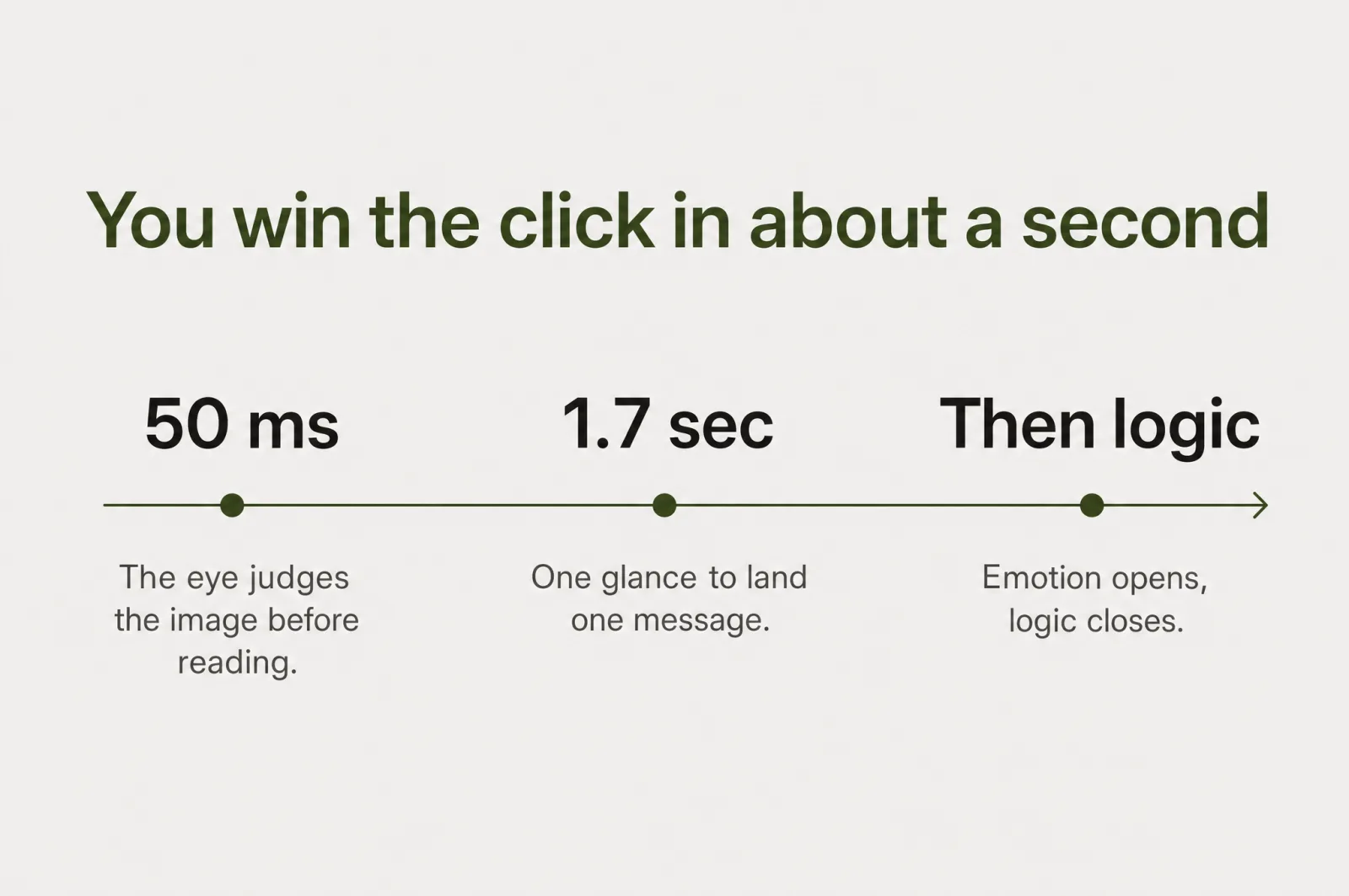
You win or lose the click in about a second, before anyone reads a word.
In a mobile feed, people spend on average 1.7 sec with a piece of content, against 2.5 sec on desktop [2]. A visual first impression forms even faster, in roughly 50 ms [3]. That is not enough time to read a feature list or weigh a pitch. It is barely enough to feel something.
The reason sits in how people decide. We run on two systems: a fast, intuitive, emotional one, and a slower, deliberate one [4]. The scroll is pure fast-brain. Attention goes to whatever triggers a feeling in a fraction of a second. The rational brain shows up later, to justify the click you already made.
Picture two ads for the same coffee grinder. One reads "40mm conical burrs, 31 grind settings, stainless body." The other shows a single perfect pour and the line "cafe-grade coffee at home." The first is a spec sheet. The second is a feeling. At feed speed, the feeling wins every time.
So the click is won on emotion and one clear idea, never on completeness. A creative that tries to say five things says nothing.
The anatomy of a click-earning creative
Five rules separate creative that earns the click from creative that decorates the feed. None of them needs a designer.
- Lead with one outcome, not a feature list. Pick the single strongest thing the shopper gets and build the whole creative around it. Meta's own guidance is blunt: get your main message across in the first seconds, "clear, concise, single-minded" [5]. "Cuts your morning prep in half" beats "27 features and 4 awards." One promise, felt fast, beats a spec sheet nobody reads in 1.7 sec.
- Make it concrete, not vague. "Stays cold for 24 hr" beats "premium insulation." Specific claims feel true; vague ones feel like every other ad. In testing, plain, factual copy scored 27% higher than the same message written in vague, promotional language [6]. Real numbers, materials, and outcomes carry the click.
- Put the product in the first frame, legible at a glance. Show what you sell right away, at thumb size, on a phone. The classic miss is a lifestyle shot so busy the product ends up a speck in the corner. If a shopper cannot tell what it is in 0.5 sec, the creative is wallpaper. Design for sound-off and small screens, because that is where it gets seen [5].
- Speak the buyer's own words. The fastest route to a felt click is to name the thing your shopper already cares about, in their language. That is not a guess. It is sitting in your reviews and your competitors' reviews. Open 3 of your 5-star reviews and 3 of your 1-star reviews. The 5-stars hand you the outcome to promise; the 1-stars hand you the objection to answer in the same frame. Build the hook from that and you pull the qualified click: the shopper who recognizes their own problem in your ad.
- Match the creative to the placement. A Facebook ad creative and an Amazon main image are not the same job. On Amazon, the main image is the one shown in search results, and it decides whether a shopper ever opens your listing [7]. Click-through there often sits near 0.3 to 0.8%, and strong performers reach 1 to 2% or more [8]. That makes the main image the one creative you cannot afford to get wrong. In a feed, motion and a scroll-stopping opening frame matter more. Same principles, different execution.
A click is a promise. Win the sale, not just the scroll.
The click sets an expectation. Whatever the shopper sees next has to keep it.
A brilliant hook into a weak landing page or a thin gallery burns the click you paid for. You have felt this as a shopper. A slick ad promises one thing, you tap through, and the page is a wall of specs that never mentions it, so you leave.
Your shoppers do the same. The creative made a promise, and the destination has to pay it off. This is ecommerce conversion optimization starting at the creative, not after the click.
That is why strong creative is judged on two brains at once. The emotional side wins the click: does it look premium, does it make the outcome feel real? The logical side wins the sale: does it communicate clearly, does it answer the real objection? A creative can look great and argue badly, or argue well and look cheap. Both quietly cost you.
On a listing, this is the gap between the main image that earns the click and the gallery that closes it. One attraction shot to stop the scroll, then a set of images that handle the doubts and confirm the buy. Design the whole path, not just the hook.
How to build an AI ad creative that converts, without a designer
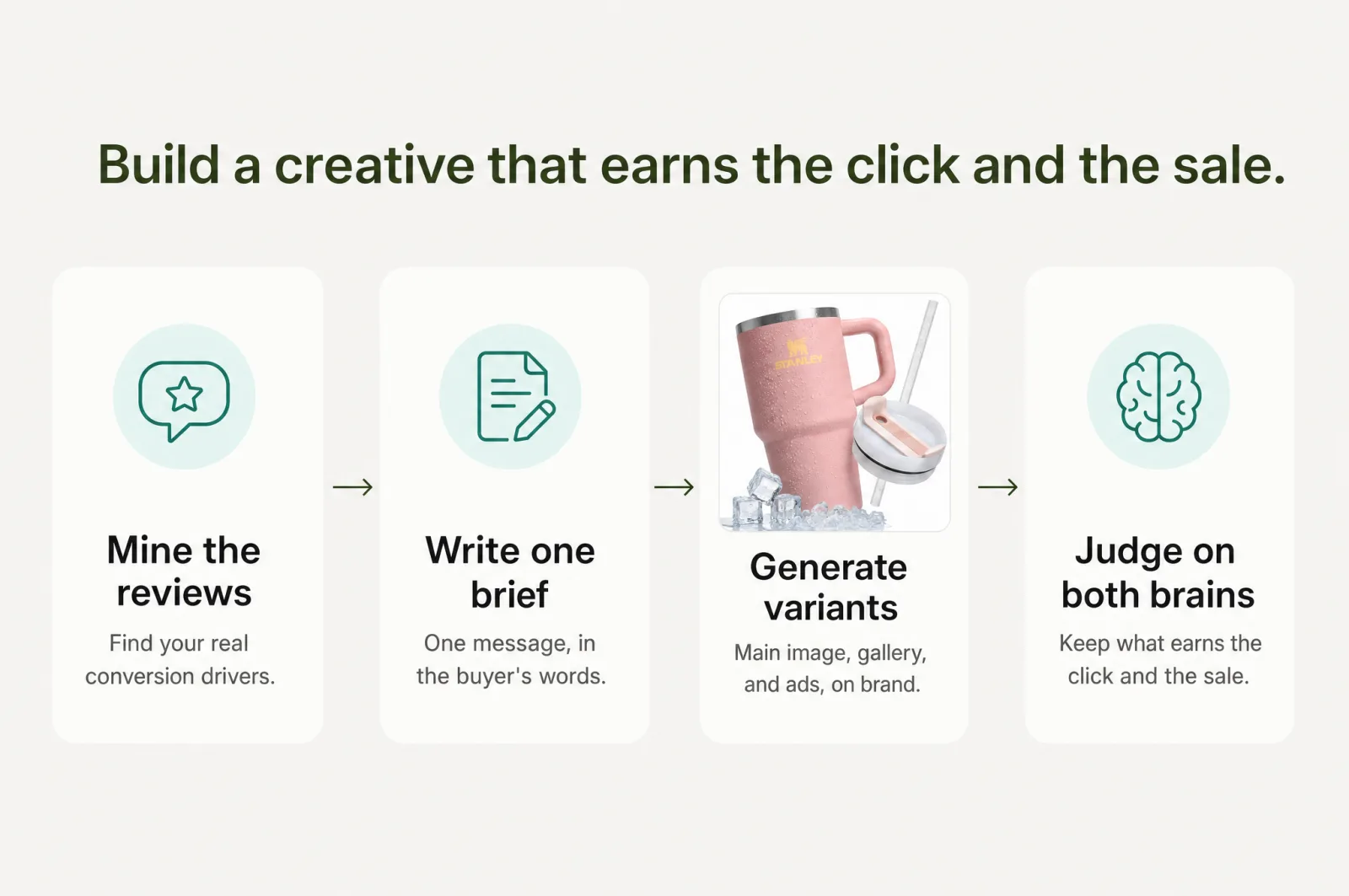
You do not need a studio or a prompt-engineering habit. You need the buyer data and a system. Here is the method:
- Mine the reviews for drivers. Read your product's reviews and your top competitors' reviews. Tag what people praise (your outcomes) and what they complain about (your objections). Rank both by how often they come up. The top 2 or 3 are your conversion drivers, the things that move the sale.
- Turn each driver into a brief. One creative, one message: the praised outcome up front, in the buyer's words, with the common objection answered in the same frame. Match it to the placement.
- Generate on-brand variants for every placement. The same brief becomes an Amazon main image, a gallery set, a Facebook or Meta ad creative, and an AI product ad, from one source, so the whole set looks consistent instead of stitched from five vendors.
- Judge the winners on both brains. Keep the creative that earns the click and the sale, not the one with the highest click count.
Say you sell an insulated water bottle. The reviews rave that drinks stay cold overnight and complain that the lid leaks in a bag. Your top driver is "cold for 24 hr"; your top objection is that leak. So the main image leads with the cold-hours promise, and the ad creative shows the bottle upside down in a packed gym bag, dry. One outcome, one objection, one frame.
A word on "AI creative looks like slop." It does, when it is a pretty picture with no strategy behind it. Good ecommerce product photography is not a slicker render; it is strategy and brand applied to a real product. Lock your look first (colors, type, and models), build from real review data, and the output looks like you made it, not a stock generator.
This is what Scalable is built to do. It reads up to 500 of your reviews and your competitors', then ranks the real conversion drivers and the gaps your listing never answers. Each one becomes a creative brief for every slot.
You pick a strategy, and the main image alone ships with 21 proven click-through approaches. You lock your look with a brand kit. Then you generate main images, gallery, and Meta or PPC ad creative on brand, in minutes, no prompting.
Agencies run it per client, white-labeled, and scale the book without adding headcount.
Brands and agencies push more than 127k assets and roughly 12k products through it every month. The point is not prettier pictures. It is creative built to earn the click and the sale, from data instead of guesses.
Start with one creative
Do not overhaul your whole account this week. Prove it on one.
Pick your best product. Build a single data-backed creative: one outcome, in your buyer's words, with the product in the first frame. Judge it on both brains, then let the results decide the rest.
You can start free. Your first product analysis and first brand kit are included, so you see a real creative before you spend a cent on traffic.
Build your first data-backed creative, free →
Frequently asked questions
- Why are my ads getting clicks but no sales?
Because clicks and sales are different jobs. A creative can win the scroll with a curiosity gap or a bright badge and still pull in people who were never going to buy. Most clicks never convert, even high-intent ones. The fix is to build the creative around one outcome your real buyers care about, so the click comes from a shopper who is ready to purchase, not just curious.
- What makes a good ad creative?
One clear message, felt fast. Pick a single outcome the shopper wants, show the product in the first frame, keep it legible at thumb size, and phrase it in your buyer's own words. Then make sure the page behind the click keeps the promise. Good creative wins the click on emotion and the sale on clarity, and it is built from real buyer data, not guesses.
- How many ad creatives should I test?
Enough to find a winner, but each built on a real angle, not random noise. Start from your conversion drivers, the handful of things your reviews show move people to buy, and build one creative per angle. Test them, judge them on conversions rather than clicks alone, and scale the ones that earn the sale. A few data-backed variants beat dozens of guesses.
The principles match; the execution differs. Both have to land one message fast and show the product clearly. On Amazon, the main image is what shoppers see in search, so it drives the click into your listing. In a social feed, motion and a scroll-stopping first frame matter more. Build both from the same buyer data, then adapt the format to the placement.
Sources
- 1.Unbounce: Conversion Benchmark Report
- 2.Meta / Facebook IQ: Capturing Attention in Feed
- 3.Lindgaard et al. (2006), Behaviour & Information Technology: 50-millisecond first impressions
- 4.Kahneman: Thinking, Fast and Slow (APA record)
- 5.Meta for Business: Adopt a mobile-first creative approach
- 6.Nielsen Norman Group: Concise, Scannable, and Objective
- 7.Amazon Seller Central: Product image guide
- 8.EcomRanker: Amazon main image CTR benchmarks
- 9.Design for the Amazon thumbnail: listing images that still sell on a phone
Built by someone who’s lived it.
I’ve been in e-commerce since 2018. I built and exited my own brand, then spent 5+ years running a creative agency for product companies, shipping the listings, ads, and content that move real sales.
Filed under
Launch your full Amazon listing in minutes, in-house and on-brand
Main image, gallery, A+, ads, translations and variations. Built on your reviews, optimized for conversion.
Next recommended read
How to make an Amazon main image that wins the click
Your Amazon main image decides the click. Learn what moves CTR, what the rules allow, and how to test a portfolio of proven strategies fast.
8 min read
More on this topic — playbooks and product deep-dives.
Design for the Amazon thumbnail: listing images that still sell on a phone
Most shoppers meet your listing as a tiny Amazon thumbnail on a phone. 5 rules for listing images that stay legible and sell at small size.
The Q4 catalog refresh: Amazon listing optimization for peak season without a photoshoot
Amazon listing optimization for Q4: refresh every listing for Prime Day and BFCM without a photoshoot. What to change, what to leave, and a dated plan.

The EU AI Act and ecommerce: what you actually have to do about AI content
What the EU AI Act means for ecommerce brands using AI content: the transparency rule that matters, the 2026 timeline, and a plain checklist. Not legal advice.